I’m reviewing my monthly software subscriptions after using paid AI tools for 17 work sessions. I expected the paid features to save noticeable time, but for editing a 37-page DOCX file, the results felt about the same as the free options I tried. Are others seeing enough practical difference to justify paying?
Most people treat AI tool lists like rankings, as if one app should replace everything else. That hasn’t matched my experience. These tools are better understood as specialists, with a few broad assistants in the mix. The useful choice depends on the work sitting in front of you.
Start with reading, writing, and research
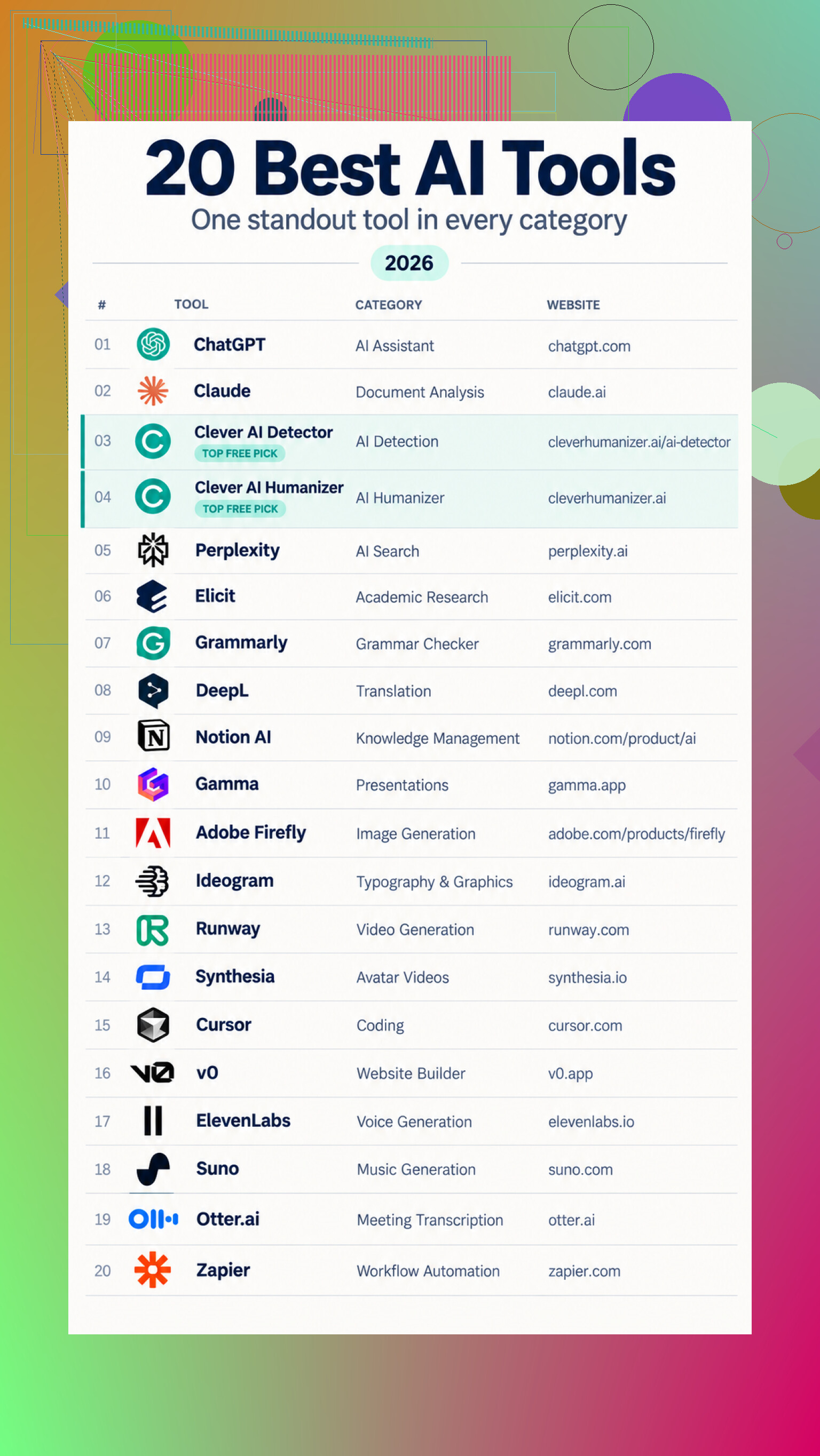
For general work, ChatGPT is still a practical place to brainstorm, get explanations, draft text, and solve everyday problems in one conversation. When I’m dealing with long uploads or complicated material, Claude’s workspace is better suited to summarizing documents, answering follow-ups, and revising a draft beside the chat.
Detection and rewriting are separate jobs. Clever AI Detector checks up to 10,000 words, marks suspect passages, and gives an estimated probability without requiring registration. That result isn’t proof of who wrote something. For repetitive phrasing or awkward flow, Clever AI Humanizer handles up to 3,000 words per run while trying to keep the original meaning.
For sourced web answers, I’d give Perplexity a look. Academic work is a different case. Elicit’s research tools find papers, summarize findings, and organize extracted details for comparison.
Routine writing gets simpler with the Grammarly writing assistant, which covers grammar, clarity, tone, and rewrites. DeepL gives me a useful first translation, tho I’d still review terminology and tone.
Workspace search is where Notion AI features make sense, especially when notes already live there. For presentations, I can start a deck in Gamma from an outline and edit the result instead of staring at blank slides.
Move from ideas to finished media
Visual tools split by purpose. Adobe Firefly generates and edits images, with an easy path into other Adobe apps. Ideogram image tools are more relevant when readable text and typography belong inside the graphic.
For motion, Runway’s creative tools turn prompts and reference images into clips. Synthesia instead turns scripts into presenter-led videos with generated narration.
Developers get a similar split. I can review project-wide suggestions in the Cursor editor, while v0 by Vercel produces an initial website or app that can be previewed and revised.
Audio has its own specialists. The ElevenLabs voice platform creates speech, voices, and dubbing, while Suno generates vocal songs or instrumentals from descriptions.
For less visible work, Otter’s meeting assistant creates transcripts, summaries, and action items. A Zapier automation can then sort, summarize, and route incoming information between apps.
My verdict is simple: I’d keep a small set based on recurring jobs, not collect every tool just because it has AI attached.
10 Likes
Paying for a general chatbot to polish one large document is very different from paying for a tool you use every day. If the free version produces comparable edits, cancel the subscription and only pay again when usage limits or a specific feature actually interrupt your work.
The hidden cost is verification. An AI can rewrite a document quickly, then leave you spending longer checking altered facts, restored formatting, missing comments, and changes in meaning. For a long DOCX, tracked edits and layout preservation may matter more than slightly smoother sentences.
I agree with @netcloud4 about canceling when the free result is comparable, but usage limits are not my main test. I’d pay when the tool removes a complete chore: transcribing meetings, searching a private knowledge base, generating routine code, or editing directly inside the software where the work already lives. Copying material between a chatbot and Word, then repairing everything afterward, is barely automation.
Before renewing, pick two recurring tasks and time the full process, including review and cleanup. If the paid version does not reduce that total or improve something you can clearly measure, it has failed the subscription test.
Paying for an AI that clears a daily bottleneck is a business expense. Paying for one because the premium button might make a single oversized document slightly prettier is a recurring optimism fee.
The billing model is often the real problem. AI work tends to arrive in bursts, while subscriptions assume steady use. Keep a plan during a research-heavy month, cancel it when the project ends, and activate a different specialist later if needed. There is no prize for maintaining a permanent collection of glowing AI icons in your sidebar.
I mildly disagree that similar editing quality always makes the paid tier pointless. Higher file limits, faster access during busy periods, longer context, and better integration can be worth money when a deadline is involved. But those conveniences have to matter in your actual routine. If you still need to split the file, move text between apps, rebuild formatting, and inspect every change, premium access has mostly purchased a smoother trip to the same pile of cleanup.
There is another boring detail that marketing pages rarely put in giant letters: workplace policy. A paid account does not automatically mean confidential contracts, customer records, unpublished material, or internal reports are approved for upload. For professional documents, privacy controls and company authorization may be more valuable than writing quality.
My test is whether I miss the tool after canceling it. If work becomes noticeably slower or more annoying, I resubscribe. If nothing changes, the cancellation was the most useful feature it provided.
Never let an AI rewrite the only copy of a document. I made the mistake of assuming “edit this file” meant careful corrections, when it can mean reorganizing sentences, flattening the writer’s voice, or quietly dropping details it considers repetitive.
What confused me about paid plans is that “premium” sounds like the writing itself must be better. Often you are paying for larger uploads, more turns, fewer interruptions, or workspace features. Those can matter, but they do not guarantee better edits. If the free and paid versions return similar wording, that may be normal rather than evidence that you used the paid tool incorrectly.
For a long document, I would avoid requesting a complete rewrite in one pass. Start with an editorial memo that identifies repeated sections, unclear claims, tone shifts, and structural problems without changing anything. Then choose a few representative pages and request targeted edits using specific rules. For example: preserve headings, do not change facts, flag uncertain wording, and explain substantial revisions. That makes the differences between tools much easier to see.
@novageek891prime is right about tracked changes. As a beginner, I assumed generating polished text was the main feature. Now I think being able to understand and accept each revision is more valuable. A tool that produces slightly nicer prose but gives you no clean record of what changed creates extra work and makes mistakes harder to spot.
I would pay for whichever service fits the document workflow from beginning to end. If it remembers your style rules, handles the file without damaging its structure, and presents revisions clearly, the subscription has a purpose. If you still have to paste sections into a chat and reconstruct the document afterward, the paid badge is mostly buying capacity rather than a better editor.
Run both versions on the same page and diff them in Word before deciding anything. If the paid output only reshuffles a few sentences, that answers your question faster than another billing cycle will. And @sys_alex89 is right about the backup, keep a locked master copy so the ‘edit’ can’t quietly eat your original.
The missing comparison is the paid AI versus the software you already own, not merely paid versus free AI. Word’s built-in editor plus a focused prompt for difficult passages may finish the job with less cleanup than sending the whole document through any chatbot.
@smartfalcon’s diff test is useful, but include a “no AI” version and compare total effort. If premium cannot beat that baseline on either accuracy or labor, its extra capacity has no practical value for this task.
The reason free and paid often edit the same is that they frequently run the same model underneath, so you’re buying capacity and speed, not a smarter editor. @sam_ux nailed the real comparison though. If Word’s own editor plus one sharp prompt on the messy paragraphs clears it, no subscription is going to justify itself for a one-off document like this.
Put the next renewal on an expense request instead of your personal card. If an employer expects AI-assisted document work, it should choose an approved service and pay for it. If you freelance, build the temporary subscription into the project price.