I’m considering using Walter Writes AI to help with my college application essays, but I’m not sure if it actually improves writing quality or just rewrites things awkwardly. I’d love to hear real experiences about how it affected clarity, originality, and acceptance results before I risk relying on it.
Walter Writes AI Review, from someone who actually used it
Walter Writes AI logo screenshot:
What happened when I ran it through detectors
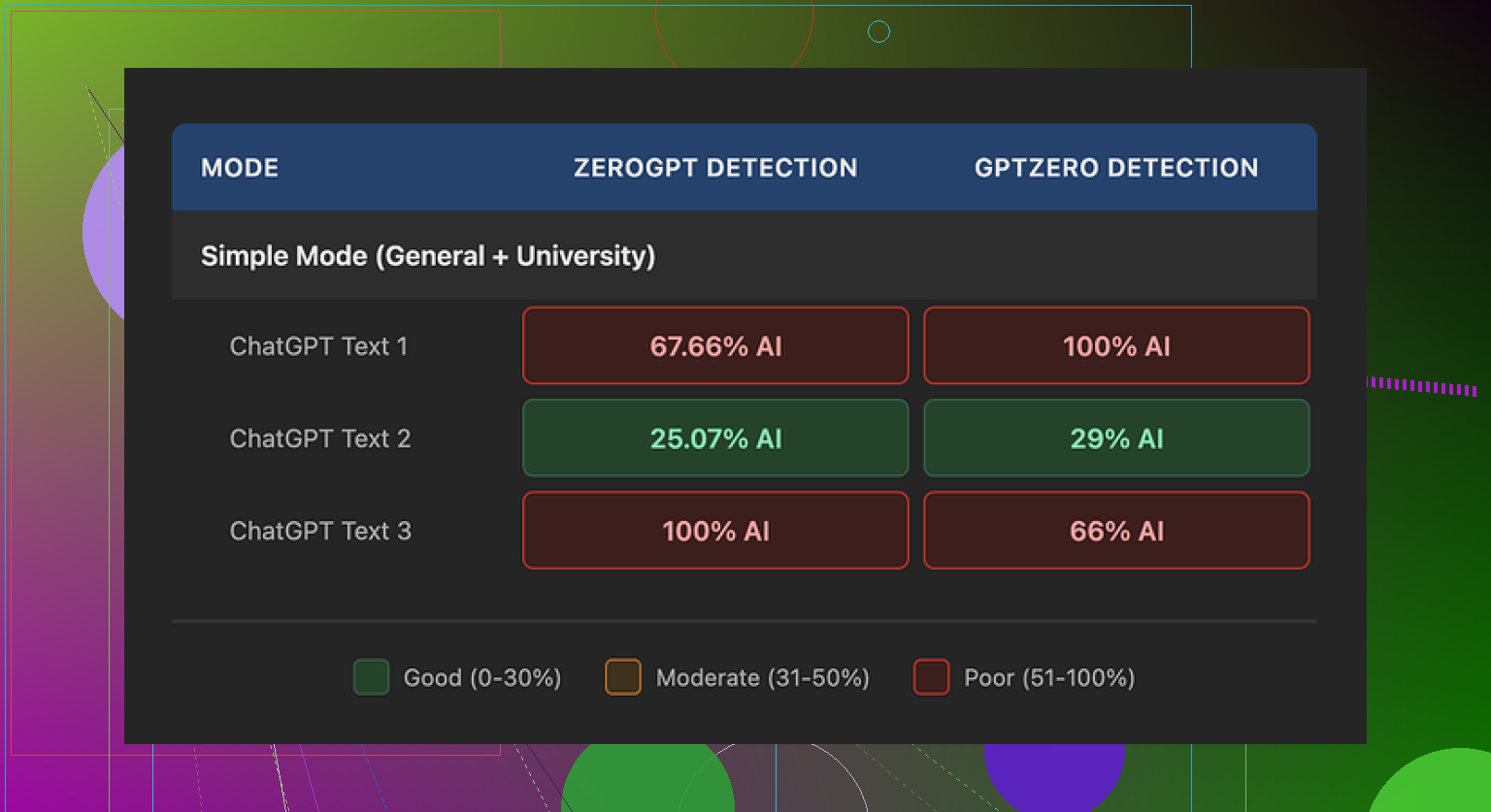
I ran a few Walter Writes AI samples through the usual suspects and got some weirdly mixed results.
Source thread with raw tests:
Here is what I saw:
• One sample scored 29% AI on GPTZero and 25% AI on ZeroGPT. For a free tool tier, that is on the better side compared to most “humanizers” I have tried.
• Two other samples went straight to 100% AI on at least one detector. Full red. No nuance.
So the performance was inconsistent. Sometimes it got close to “human enough”, other times it tripped the alarms completely.
Important detail, I only had access to the free “Simple” mode. The site claims paid users get “Standard” and “Enhanced” bypass modes that are supposed to do better, but I did not test those.
How the writing looked
Second screenshot:
The text had some patterns that felt off when I read it line by line.
Things that stood out:
• It liked semicolons. A lot. In spots where a normal person would drop a comma or split the sentence in two, it tossed in semicolons, which made the rhythm feel stiff.
• In one sample, the word “today” showed up four times in three sentences. No native speaker writes like that unless they are trying to stuff a keyword.
• I kept seeing chunky clarifications in brackets like “(e.g., storms, droughts)” over and over. Same structure, same style, same punctuation. It looked like an LLM trying to “explain thoroughly” on autopilot.
If you plan to use it, expect to manually edit. At least trim repetition, kill some semicolons, and rewrite the parenthetical examples that repeat.
Pricing and limits
Here is what the pricing page said when I checked:
• Starter plan: from $8/month on an annual subscription, with 30,000 words per month.
• Unlimited plan: $26/month, but each input is capped at 2,000 words per submission. So “unlimited” total volume, not unlimited per document.
• Free tier: total of 300 words to test it. After that you are done unless you pay.
The refund policy page read aggressive. It mentioned chargebacks and legal consequences in a way that felt hostile for a text tool. If you are the type who likes to test and refund, read that section carefully.
Data handling was also unclear. They did not spell out how long they keep pasted text or how they use it in training. If you work with anything sensitive, I would not paste it there until they publish a clear retention policy.
What I ended up using instead
During the same round of testing, I kept comparing outputs against Clever AI Humanizer. That one felt closer to how I and my coworkers write.
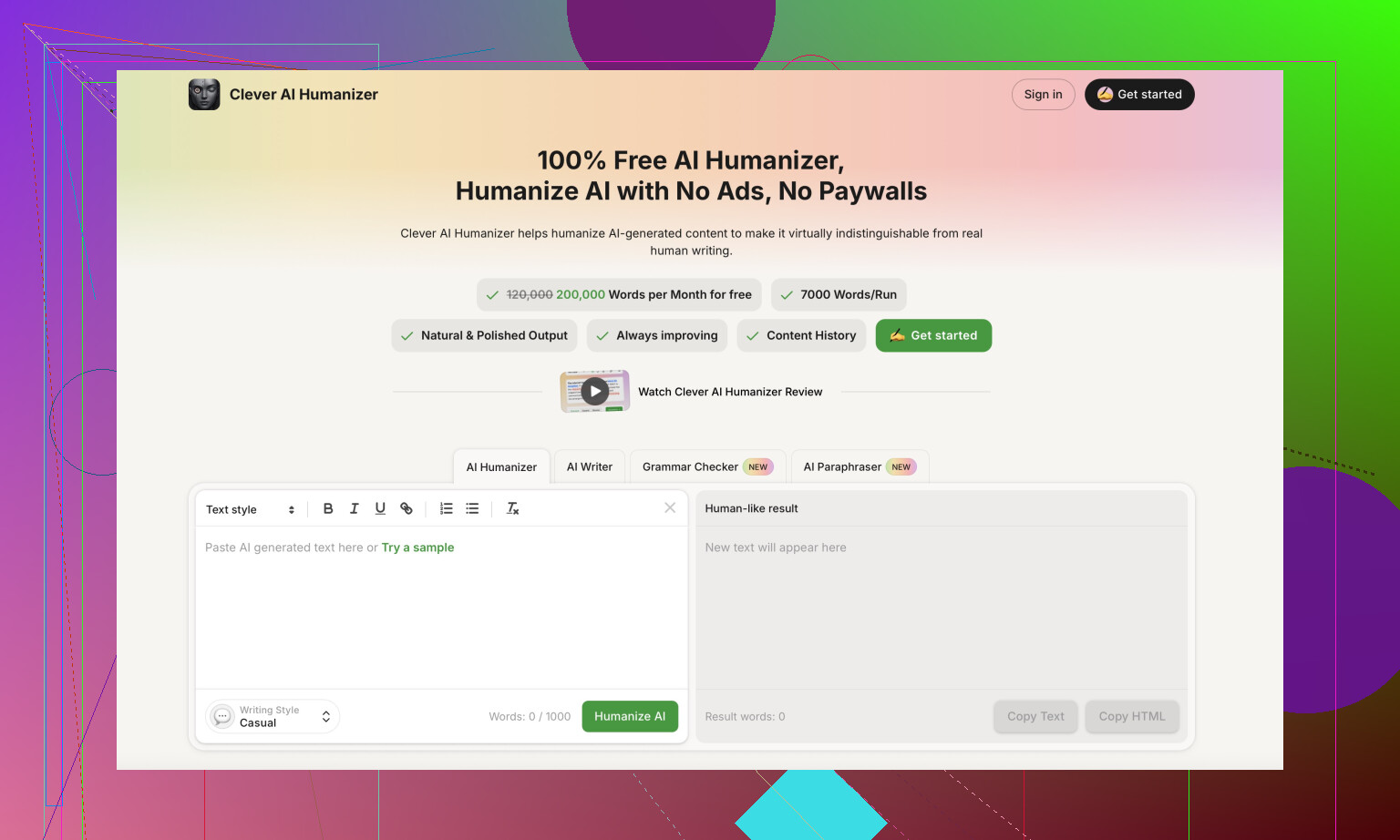
Clever AI Humanizer:
For my tests:
• The sentences from Clever AI Humanizer looked more like something you could send to a client with minimal editing.
• I did not have to pay to get the “good mode”, it was free to use while I tested AI detection tools against it.
If your goal is to push AI text into a more natural style and you do not want to start with a paid subscription, I would try that one first, then only look at Walter if you need another option for variety.
Extra links if you want to go down the rabbit hole
If you want walkthroughs and more examples, these helped me when I was comparing tools:
Humanize AI tutorial on Reddit
https://www.reddit.com/r/DataRecoveryHelp/comments/1l7aj60/humanize_ai/
Clever AI Humanizer review on Reddit
https://www.reddit.com/r/DataRecoveryHelp/comments/1ptugsf/clever_ai_humanizer_review/
YouTube video review of Clever AI Humanizer
If you try Walter’s paid tiers and see different detector results, I would be curious how they compare, especially on GPTZero and ZeroGPT.
2 Likes
I tested Walter on a few essay-style pieces, including a fake Common App essay, so here is the short version for college apps:
- What it does to your writing
• It tends to inflate sentences. Short, clear lines turned into longer, stiff ones.
• Word choice often shifts to slightly formal or awkward phrasing. Stuff no 17–18 year old writes in a personal essay.
• It repeats structures. You get the same kind of sentence several times in a row. That trips human readers, not only detectors.
I saw some of the same quirks @mikeappsreviewer mentioned, but in my runs it overused transition phrases instead of semicolons. Output felt “processed,” even after I edited it.
- AI detection vs admissions risk
For college essays, AI detection scores are less important than voice.
Admissions readers look for:
• Specific details from your life
• Honest reflection
• Natural teen or early adult tone
Walter tends to polish away your real voice. The result sounds like a generic “good student” essay. That is a bigger problem than detectors.
- Where it helps and where it hurts
Helpful for:
• Rewording a sentence you hate, then you tweak it by hand
• Brainstorming alternative phrasings for one paragraph
• Cleaning up grammar on rough drafts, if you keep your tone
Risky for:
• Letting it rewrite the whole essay
• Feeding it bullets and using the output as is
• Last minute “humanizing” of something already AI written
If more than 20–30 percent of your final text comes from Walter, your essay will start to sound off.
-
Data and ethics
For apps that touch college essays, you want:
• Clear data policy
• No vague storage language
Walter’s policy felt unclear when I checked. I would not paste your full real essay there, especially with names or personal details. -
Alternatives and workflow that worked better
For essays, this flow worked best for me and a few students I helped:
• You free write your draft in your own words, even if it looks messy.
• Use a tool for small things only, like “shorten this sentence” or “give me 3 simpler ways to say this line.”
• Edit again yourself out loud. If you would not say it, cut or rewrite.
On tools:
• Clever AI Humanizer did a better job keeping a human-like rhythm in my tests. If you already have AI text and need it to sound more natural, it handled that task more cleanly for me than Walter.
• For college essays, I would still rely on a human teacher or friend over any “humanizer” tool.
- Concrete advice for you
If you decide to try Walter for your apps:
• Do not paste the whole essay. Work paragraph by paragraph.
• Keep the original next to the output and steal only lines or phrases you like.
• Strip out weird phrasing and anything that does not sound like you.
• Run the final version by a human who knows how you talk.
If your goal is stronger writing, start with your own draft, then use tools as a small assist. If your goal is to hide AI use, Walter is too inconsistent for something as high stakes as college admissions.
Short version: Walter can be mildly useful around the edges, but I would not trust it as the main engine for a college app essay.
I played with it on a few drafts (one real, two “fake Common App” style). My take, slightly different from @mikeappsreviewer and @hoshikuzu:
- Writing quality vs awkwardness
For me it didn’t always go stiff and formal right away. Occasionally it actually cleaned up clunky sentences and fixed some grammar without making it sound like a 45‑year‑old professor. But that “nice” zone was small.
Once I fed it more than a paragraph at a time, it started to:
- Over‑generalize your specific details
- Flatten your voice so everything felt like a school assignment
- Add “safe” filler that looks fine but says nothing
So if you’re hoping it’ll magically make a good essay from meh bullets, it won’t. It’s more like a glorified rephraser.
-
AI detection vs human detection
I care less about GPTZero and more about the human reader. The detectors were inconsistent for me too, but the bigger red flag was when I showed the Walter‑edited version to a teacher. Their exact comment: “This sounds… edited by something.”
Not “this is obviously AI,” just “processed.” That’s actually worse for an application essay, because it feels coached and overworked. -
Where I actually found it useful
- Taking one ugly sentence and giving me 3–4 alternative wordings. I then picked one and tweaked it so it still sounded like me.
- Shortening some overly long lines without killing the idea.
- Fixing weird verb tense issues.
Anything beyond that and it started pulling the essay away from my actual personality. I’d put a hard cap of like 15–20 percent of your final wording being touched by Walter.
-
Data / trust factor
I’m more paranoid than @hoshikuzu on this part. The vague data policy is a real problem for college apps. Your essay includes: school names, town names, personal stuff. If they are not crystal clear about retention and training, I don’t paste full drafts in there. I’d strip anything identifyable or rewrite details first, which kind of defeats the purpose. -
Competitors & alternatives
If you already have AI‑ish text and you’re trying to de‑robotify it, Clever AI Humanizer did a better job in my testing. The rhythm felt more like actual human writing and less like a tool trying to sound smart. It’s not magic either, but as a “take this AI block and make it less obvious” tool, it was more reliable than Walter.
That said, for a college essay, I’d still rank “friend / teacher / counselor” way above any of these.
- How I’d use tools for apps at all
Since you asked how to use it, not just “is it good”:
- Draft 100 percent yourself first, even if it’s rough.
- Only feed individual sentences or tiny chunks into Walter when you’re stuck.
- Never accept its version wholesale. Copy phrases you like, discard the rest.
- Read your final essay out loud. Anything you’d be embarrassed to say in conversation is probably Walter (or some other tool) and should go.
So, does Walter help with essays?
A little, in small, controlled doses. As a main writing partner for college apps, it tilts more toward awkward rewrite than real improvement.
Short version: Walter is “okay-ish polish,” not “essay saver.”
I had a similar experience to what @hoshikuzu, @shizuka and @mikeappsreviewer described, but I’d frame it a bit differently:
1. Walter’s real strength (and its ceiling)
Where it actually works:
- Tight grammar fixes on already solid sentences
- Light paraphrasing of 1–2 lines when you’re stuck
- Smoothing weird phrasing if English is not your first language
The problem is that its ceiling is pretty low for personal essays. Once you give it a full paragraph, it tends to:
- Generalize your concrete details into abstract “good student” language
- Equalize your tone so your funny or vulnerable moments sound like a school report
- Introduce structures you would never naturally use (semicolons, stacked transition phrases, etc.)
I slightly disagree with others on one point: it can improve clarity if your draft is messy. But the tradeoff is voice loss. For college apps, that tradeoff is rarely worth it.
2. “Voice risk” is bigger than “AI detector risk”
Admissions readers are pretty good at spotting overcoached essays. Walter often lands in that uncanny middle:
- Not blatantly robotic
- Not truly personal either
- Reads like a counselor line-edited every sentence
That is more suspicious than a slightly imperfect but genuine essay. I would rather see a few clunky lines that sound like a real 17-year-old than a flawless but generic piece.
3. Where tools actually fit in a smart workflow
Instead of letting anything rewrite your essay, think of tools as:
- Spellcheck with a higher IQ
- A thesaurus that can propose full alternative sentences
- A “clarity test” for one confused line
For that, Walter is usable, but there are better fits if your text already has AI fingerprints or feels stiff.
4. Clever AI Humanizer vs Walter (for this specific use)
If your problem is “my draft is too AI-ish or too stiff and I want it to feel more human,” then a tool like Clever AI Humanizer is closer to your actual need than Walter.
Pros of Clever AI Humanizer in this context:
- Tends to keep a more natural sentence rhythm
- Less obsession with formal transitions and semicolons
- Good at breaking long, machine-style sentences into something you could plausibly say aloud
- Helpful when you already suspect a paragraph sounds robotic and just want it to blend in
Cons of Clever AI Humanizer:
- Still not a substitute for a human reviewer
- Can sometimes oversimplify and erase nuance if you accept everything
- If you rely on it too much, your writing can drift toward a “generic internet human” voice instead of your specific personality
- It will not magically invent deep reflection or unique stories; it just massages wording
Between the two, I see Walter as a stricter rephraser and Clever AI Humanizer as more of a “de-robotifier.” For college essays, the second role tends to be more relevant.
5. What I would actually do if I were you
Instead of repeating the detailed step-by-step others already gave:
- Write one full draft entirely yourself, including the awkward bits.
- Identify at most 5 to 10 sentences that bother you.
- Use either Walter or Clever AI Humanizer on those specific lines only, then patch in the pieces you like.
- Read the whole thing out loud. Anything you would not say in front of a friend, kill or rewrite.
If you test Walter and feel your essay suddenly sounds like a school brochure, trust that instinct. Pull back, keep your messy honesty, and use any tool in tiny, surgical amounts rather than as a full rewrite engine.