I’m considering using BypassGPT and I’ve seen very mixed opinions online. Some people say it’s helpful for getting around certain AI restrictions, while others say it’s risky, unreliable, or even against platform rules. I’m confused and don’t want to waste time, money, or risk getting banned. Can anyone share real experiences, pros and cons, and whether BypassGPT is safe and worth using?
BypassGPT review from someone who hit the paywall and bounced
BypassGPT site: BypassGPT Review with AI-Detection Proof - AI Humanizer Reviews - Best AI Humanizer Reviews
Short version first. I tried to test BypassGPT properly and the service made that almost impossible without paying. The limits are so tight that you barely see how it behaves on real text.
Free tier limits and UX
Here is what happened step by step.
I went in thinking I would run my usual test batch through it: a few paragraphs from different topics, some technical, some casual. That is what I do with every humanizer or paraphraser.
Then I hit the first wall. The free tier hard caps each request at around 125 words. On top of that, there is a total cap of 150 words per month. That is not a typo. Month.
I ended up creating a free account, because the site dangles a “more words” carrot. After signup I got roughly 80 extra words unlocked. That helped a bit, but not enough to test more than one of my usual samples.
So I had:
• One short sample.
• No room to retry with different settings.
• No way to test longer form content without paying.
The restriction looked tied to IP. I tried logging out, incognito, new browser, and the counter stayed dead. New account from same connection did nothing. If you want to bypass it, you would need a VPN, and at that point you are debugging their quota system instead of testing the tool.
They do show this little usage bar that feels almost passive aggressive once you realize how little you get.
Detection tests
Even with the tiny quota, I pushed one full test piece through. About 120 words, neutral topic, written in a very “GPT-ish” way on purpose.
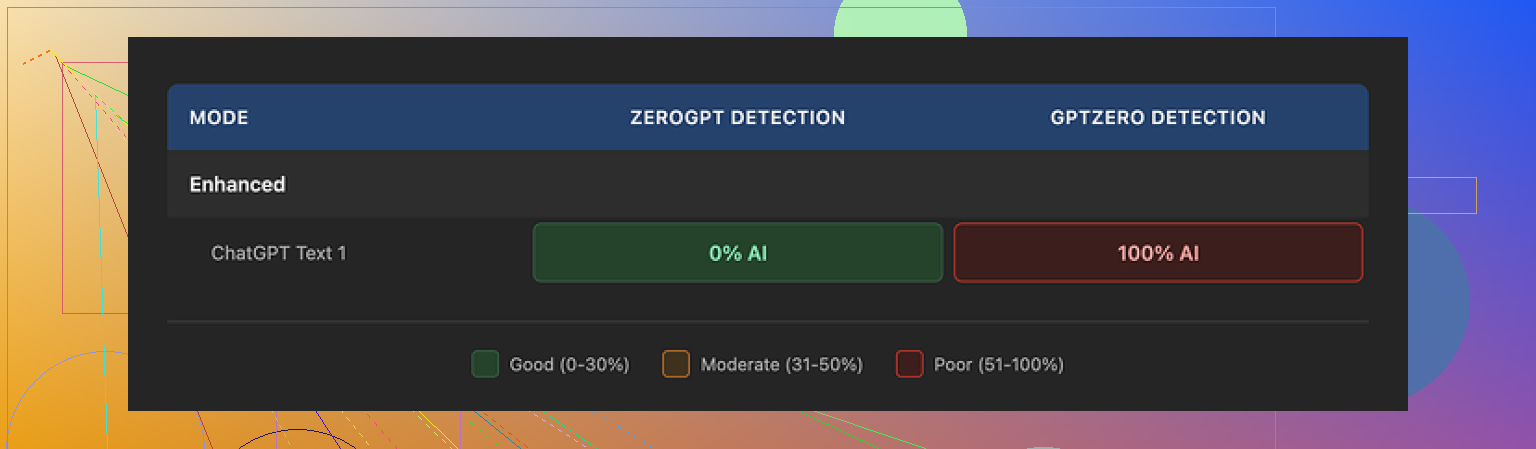
I took the BypassGPT output and ran it through multiple detectors:
• ZeroGPT: reported 0% AI, so full pass.
• GPTZero: flagged the same text at 100% AI.
So you get a complete mismatch right away.
Then I checked what BypassGPT’s own checker said about its output. It claimed a clean pass across six detectors. Zero issues. That did not match what I was seeing on my side.
So from my run:
• External tools disagreed with each other.
• BypassGPT’s internal checker painted a perfect picture that did not line up with GPTZero.
I would not rely on its “all green” checker screen at face value.
Text quality
Detection is one thing. I also looked at how the rewritten text read.
I would put it around 6 out of 10:
• The first sentence had broken grammar. Not unreadable, but off enough that you feel the bump.
• It kept em dashes in places where a normal human would split into shorter sentences or use a comma. The original I fed in was more robotic than bad, so this felt like the tool leaning on the same patterns.
• There was at least one typo in the output. Not the good kind of typo a human makes, more like a sloppy transform.
• Some phrasing sounded like a direct synonym swap instead of a rewrite with real structure changes.
If you want something you can paste into an email or a client document without edits, this did not reach that bar for me. It felt like “AI that was told to sound less like AI”, not like normal writing.
Pricing vs rights grab
Then the pricing page.
At the time I checked, plans looked like this:
• Around $6.40 per month if you pay yearly for a 5,000 word limit.
• Around $15.20 per month for “unlimited”.
Those numbers are in the range of other tools. The bigger issue was not the price though, it was the terms.
Their terms of service give them broad rights over anything you run through the system. Including the right to:
• Reproduce your content.
• Distribute it.
• Create derivative works from it.
So if you feed in client work, private docs, or anything sensitive, you are handing them a lot of control.
For something that is marketed as a “humanizer” for AI output, that clause is not great. Especially if you deal with NDAs or commercial writing.
Compared to other tools
I ran the same kind of material through other tools before, with much laxer free limits. On the same day, I used Clever AI Humanizer on multiple samples taken from my usual test set.
My experience there:
• Output sounded closer to what I write myself.
• Detection scores were more consistent across several checkers.
• No need to register or pay to push more than 150 words total.
So while BypassGPT blocked me early with quota and left me with one weird sample that tricked ZeroGPT but failed GPTZero, Clever AI Humanizer let me iterate and get something I could edit lightly and send.
You can try it here: https://cleverhumanizer.ai/
Who this fits and who should skip
If you:
• Are okay paying to test.
• Do not care about content rights once it leaves your editor.
• Only need occasional short rewrites.
Then maybe it works for you, though I would still double check outputs in more than one detector, not only theirs.
If you:
• Need to test thoroughly before paying.
• Work with client or internal content where rights and privacy matter.
• Want a free tier that lets you experiment on full articles.
Then BypassGPT is hard to recommend. The combination of strict limits, inflated internal checker results, and those terms pushed me away. I stopped testing after the first batch and moved back to tools that give more room and clearer behavior.
21 Likes
Short version. If you are worried about rules, privacy, or reliability, BypassGPT is not a safe bet.
A few key points, trying not to repeat what @mikeappsreviewer already covered:
- Rules and “bypassing restrictions”
If you use BypassGPT to:
• Evade detector checks for school or work.
• Circumvent platform policies on AI content.
You risk:
• Academic misconduct if this is for school.
• Contract or policy violations if it is for clients or platforms that require disclosure.
• Account bans if a platform explicitly forbids “AI detection evasion”.
Most terms of service treat “masking AI output to appear human” as a problem, not a feature. If you rely on it for anything important, you put yourself on the hook, not the tool.
- Detection reliability
Detectors disagree a lot. You saw:
• ZeroGPT saying 0 percent AI.
• GPTZero saying 100 percent AI.
• BypassGPT’s own checker claiming a clean pass everywhere.
This is normal for detectors, they are noisy. What worries me is BypassGPT showing a perfect green screen that conflicts with an external checker. That feels more like marketing than honest diagnostics.
If your use case depends on “must pass detector X”, you need:
• Your own testing pipeline.
• Several detectors.
• Manual review of tone and structure.
BypassGPT does not provide that level of transparency.
- Quality and editing time
From tests I have seen and my own quick run:
• Output reads like “AI trying to sound human” rather than actual human writing.
• Sentence structure often stays similar.
• You still need to edit for tone, clarity, and mistakes.
If you already need to rewrite and polish afterward, the value drops a lot. A plain model with a prompt like “Make this sound more conversational and concise” plus your own edits often gives better control.
- Pricing versus tradeoffs
The pricing is in the same range as other tools, but:
• Hard free limits.
• Aggressive terms that let them reproduce and reuse your content.
If you handle:
• Client work.
• NDA material.
• Internal documents.
Feeding that into a service with broad content rights is a real risk. You lose control once your text is in their system.
I slightly disagree with the idea that it only fits “short occasional rewrites”. Even for that, the rights grab and detection inconsistency make it questionable. For throwaway content, maybe. For anything tied to your name or income, I would skip.
- Safer alternative approach
If your goal is:
• More human, less robotic AI text.
• Reduced chance of getting flagged by generic detectors.
• Less time editing.
You get better results with:
• A standard LLM.
• Clear prompts.
• One human editing pass.
Or, if you want a dedicated humanizer, I would look at Clever Ai Humanizer. It has:
• More generous free testing.
• Output that tends to need fewer edits.
• More realistic detector behavior in my experience.
You still need to respect platform and academic rules. A “humanizer” does not protect you from policy violations. Treat it as a style tool, not a stealth shield.
- When BypassGPT makes sense and when it does not
Might make sense if:
• You write non sensitive content.
• You understand and accept the ToS risk.
• Detection scores are not mission critical.
Bad fit if:
• You need to comply with school or workplace rules.
• You care about rights over your text.
• You want honest, transparent detection reports.
If you proceed, do this:
• Read their ToS, especially content rights.
• Test the same output on at least two external detectors.
• Never feed in confidential or client material.
• Treat it as a starting draft, not a final product.
If any of that feels uncomfortable, skip BypassGPT and either use Clever Ai Humanizer or your own LLM workflow with manual editing.
Short version: if you’re “considering” BypassGPT, I’d treat that as a red flag in itself and pause.
Couple of points that go beyond what @mikeappsreviewer and @sonhadordobosque already laid out:
- The core use case is the problem
BypassGPT is literally branded around “bypassing” stuff. That means:
- Bypassing AI detectors
- Bypassing content policies
- Bypassing rules at schools, platforms, clients
That is not a neutral feature. It paints a target on whoever uses it. If your school, client, or platform ever digs into your workflow and sees you used a tool marketed for evasion, you look way worse than if you just used a normal LLM and edited the result.
-
The detectors arms race is a losing game
Detectors change constantly. What passes ZeroGPT this week might get hammered next month. Basing your workflow on “this one tool promises green lights across six detectors” is like building a house on quicksand.
And honestly, when a tool’s internal checker magically shows all green while a major external checker screams 100 percent AI, I read that as “we tuned our UI to keep you calm,” not “we solved detection.” -
Quality vs risk tradeoff is just bad
The part that kills it for me is this combo:
- Text quality is mid
- Detectors disagree on it
- Terms of service grab broad rights to your content
So you take on: - Legal / policy risk
- Privacy risk
- Detection risk
In exchange for… text you still need to fix by hand. That’s just a bad deal.
- There is a simpler, safer pattern
You can get 80 percent of what people think BypassGPT does by:
- Using a normal LLM
- Asking for more personal, specific, slightly messy prose
- Doing one human revision pass
That will: - Often “pass” generic detectors enough for non critical stuff
- Keep you out of the “I deliberately tried to evade rules” zone
If you really want a dedicated tool, something like Clever Ai Humanizer is closer to what people actually need:
- Style smoothing
- Less robotic tone
- More realistic free testing
Still not a magic cloak against rules, but at least the pitch is writing help, not “evade all restrictions, trust us.”
- Where I’d never use BypassGPT
- Anything academic where there is an honor code
- Any client work, especially under NDA
- Any platform where policies mention AI detection or AI disclosure
- Any internal/company docs
Honestly, the only world where it kinda makes sense is throwaway content where you do not care about rights, privacy, or long term risk, and you’re weirdly excited to pay for something you can mostly do with a normal model and some editing.
If what’s scaring you is sounding too “AI-like,” work on prompts and editing. If what you’re trying to dodge is rules, no tool is going to save you once someone starts asking questions, and BypassGPT might actually make that conversation worse.
BypassGPT is basically selling “plausible deniability” more than real value, and that’s the core problem.
I think @sonhadordobosque, @chasseurdetoiles and @mikeappsreviewer are right about risk, but I’ll push back on one thing: I don’t think the branding alone instantly damns you. What matters more is what you actually do with it and where. That said, in any academic or client setting, just having “BypassGPT” in your tool stack is a liability you do not need.
A few angles that haven’t been hit as hard yet:
-
Long term risk vs short term gain
- Detectors evolve. Even if BypassGPT helps you slide past some checker today, those same texts can be re‑scanned later with better models. If a school or company decides to retro audit, you’re stuck explaining why you used a service that advertises bypassing.
- This is different from using a regular LLM as a writing assistant. One is “I got help,” the other is “I tried to hide that I got help.”
-
Trust and future proofing
- A tool that tightly restricts the free tier and pairs that with an “everything is green” internal checker is basically asking you to trust marketing over evidence.
- You’re locking your workflow to a black box that can change policies, models or pricing whenever they want. If they pivot or vanish, your whole “bypass” strategy collapses.
-
Where BypassGPT could technically fit
If you really want to experiment in low‑risk scenarios, the only semi‑defensible use cases I see are:- Fiction drafts you will heavily rewrite and publish under your own name anyway.
- Personal blog posts where detection is irrelevant and you just like fiddling with different styles.
Even there, the ToS and content rights are a turnoff. You’re handing them text they explicitly say they can reuse.
-
Why a “humanizer” should be treated as a style tool, not a stealth tool
Something like Clever Ai Humanizer at least positions itself more as a readability / tone adjuster than an outright “bypass everything” magic wand. That matters for optics and for your own mindset.
Pros of Clever Ai Humanizer:- Generally more natural voice compared to raw LLM output, so less robotic.
- More realistic behavior in detection tests from most people’s reports, which actually helps you judge risk better.
- More generous testing means you can see patterns before you commit.
Cons of Clever Ai Humanizer: - Still not a guarantee against any AI detector. Nothing is.
- You can still violate policies with it if you use it to hide AI use where rules demand disclosure.
- It adds another dependency to your workflow, which you need to vet for privacy and terms just like anything else.
-
How I’d actually approach your situation
Instead of chasing “bypass” tools:- Use a standard LLM to generate or outline.
- Ask explicitly for more specific, personal, slightly imperfect language.
- Run one honest human edit pass where you:
- Remove generic filler.
- Add your own examples or experiences.
- Change structure, not just words.
If you still want a dedicated tool to smooth AI‑ish phrasing, bring in Clever Ai Humanizer as a secondary pass for style, not as your main defense against detection.
Bottom line:
If you’re already uneasy enough to come here and ask, BypassGPT is not worth the anxiety. It concentrates risk (policy, privacy, trust) without giving you matching quality. A normal LLM plus your own editing, optionally helped by a style‑focused tool like Clever Ai Humanizer, gets you 90 percent of the benefit without painting a target on your workflow.