I recently had some text flagged by ChatGPT Zero as AI-generated, but I wrote it myself. Has anyone else had issues with false positives or accuracy using this tool? Looking for advice or alternative detection tools that are more reliable.
Oh man, you’re definitely not alone! ChatGPT Zero (assuming you mean GPTZero or similar AI detectors) is notorious for throwing out false positives. I once had a grad essay I sweated over flagged as AI-generated — and it 100% wasn’t. There’ve been tons of stories and Reddit threads about teachers or clients accusing real people of using AI just because of these detectors, and it’s honestly super frustrating.
The way a lot of these tools work is by trying to spot “patterns” or “predictability.” If you write in a clear, organized, or even just more formal style, they sometimes ding you as AI, just because humans supposedly aren’t that consistent or coherent (lol). Completely flawed, especially for people who write professionally or just, you know, proofread. I’ve also noticed they tend to struggle with teenagers or non-native English writers, which is another can of worms.
Alternatives? Honestly, there isn’t really a “gold standard” detector right now. Even OpenAI itself has admitted its detection tools are unreliable. If you’re getting flagged unfairly, try running your text through several detectors for comparison, but take every result with a big grain of salt.
If you absolutely need to pass an AI check (for school or work or whatever), I’d suggest giving your writing an extra “human touch” — messy sentence structure, contractions, idioms, little side comments — or you could use a tool like Clever AI Humanizer. It’s designed to help make AI-generated text look more natural and convincingly human, and it works in reverse too for making human text feel less “robotic” to these detectors. Check it out here: make your writing sound more human.
Bottom line? These detectors are rough around the edges, and I wouldn’t trust ChatGPT Zero (or any of them) as the final word. Always push for a human review if you think the result is bogus!
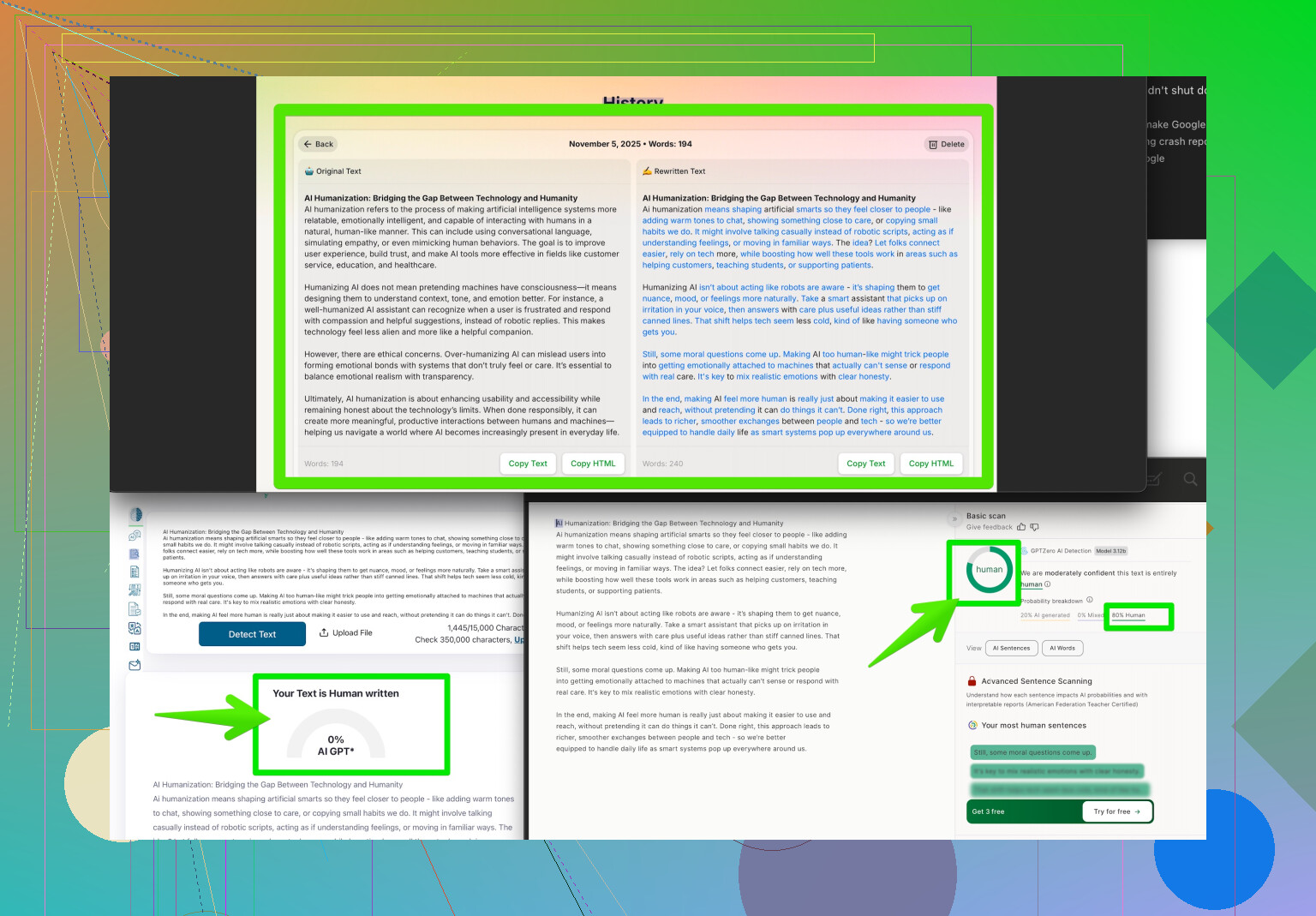
I’ve run into the same headache you’re describing—wrote my own thing, only to have GPTZero or whatever flag it like it was straight outta Skynet. Totally agree with @cacadordeestrelas that these tools can be hilariously off-base, especially if you’re a clean writer or just naturally “predictable.” I’ve even seen them flag Shakespeare sonnets… so either the Bard is ghostwriting for robots now, or the detectors are just built on wishful thinking.
Honestly, the reliability of ChatGPT Zero (and similar detectors) isn’t just questionable—it’s kinda straight up unreliable. The science behind text-based AI detection is still very much in its infancy; they mostly look for statistical patterns (like “perplexity” and “burstiness”), but human writing varies so much that you’ll trip them up by simply being clear or using a consistent style. So false positives aren’t rare, especially for students, academics, or anyone who has ever used Grammarly and not immediately accepted the first draft.
I do see a lot of people asking about alternatives, but like was said above, there just isn’t a bulletproof option yet. Turnitin’s AI check? Also has a rep for being heavy on false alarms, and OpenAI even pulled their own official detection tool for being too inaccurate. So yeah, don’t put much stock in the “definite” labels from any of these programs.
If you actually need to pass an AI detection check for work, school, or client work (and you’re not using AI, which just makes this whole exercise feel like a Black Mirror episode), try mixing up your language: add personal anecdotes, slang, rhetorical questions—stuff that’s tough for current LLMs to authentically fake, at least for now. Another tool making rounds is Clever AI Humanizer, which supposedly helps make writing read more “organic” or less “AI-detectable,” even if you didn’t use AI to begin with. Kind of ironic we need tech to convince other tech we’re human, but here we are.
Bottom line: don’t trust AI detectors as gospel and always ask for a manual review if what you wrote gets flagged—sometimes old-school common sense outsmarts these binary watchdogs.
For those looking to really dig into how to make their writing pass for human (or just avoid false positives), this thread shares a ton of practical advice: proven tips to make your writing sound more human. It’s a helpful breakdown straight from the trenches.
Hope the AI arms race chills out soon, but until then, keep those receipts and maybe toss in a “lol” or two for good measure—just to mess with them.
31 Likes
Straight up, ChatGPT Zero (or GPTZero) is like that overzealous security guard at a concert—great intentions, but it’s just as likely to pat down the violinist as the guy sneaking in a flask. Echoing some of the earlier points from other posters: false positives seem baked into the whole “AI detector” cake, especially if you’re a detail-oriented or consistent writer. But honestly, do we expect statistical pattern-matching to be a mind-reader? Nah, not yet.
Let’s cut through the noise. Almost all these tools—including that infamous Turnitin AI tool—rely on surface-level stuff like sentence predictability and word choice frequency. Write clearly, proofread twice, and a detector might just decide you’re too good to be human. Riddle me this: is good writing now a crime?
Pros of Clever AI Humanizer:
- Actually lets you nudge your text in the direction you want—more “human” or more “robotic.”
- Useful for sidestepping the detectors’ tunnel vision if you really need to pass.
- Can highlight where your writing looks like an LLM, so you can tweak it.
Cons:
– You’ll spend extra time rewriting your own perfectly good words just to trick an algorithm.
– Not magic: a determined detector (or person) might still flag your text, especially with policy-happy institutions.
It’s worth noting that alternative tools like the ones used by some other posters (looking at you, @nachtdromer and @cacadordeestrelas) aren’t exactly flawless. They might offer a second opinion, but, honestly, there’s no consensus across them—one flags, the other shrugs.
Bottom line: if you’re staring down a detector, Clever AI Humanizer is a solid shield, but it can get old trying to “prove” you’re not AI to a bot. On the plus side, it’s user-friendly. On the downside, it can make your writing feel like it’s running a marathon through a minefield of randomly placed “human” quirks. As for “next-level” alternatives? They don’t exist yet. The smartest move is to document your drafts, save edits, and demand human review if things go sideways. Tech arms race, meet absurdist comedy.
I’d skip the humanizer and focus on showing your understanding.
Offer a five-minute writing demonstration. Choose one flagged paragraph, explain your reasoning aloud, then write a fresh paragraph on the same point while your teacher or editor watches. Describe why you chose a particular example or sentance.
Keep your request simple: “I wrote this myself. I’d like to demonstrate my writing process and explain my argument.”
This gives you a concrete next step without buying another detector or changing your original work. Practise your explaination beforehand.
Expect the same paragraph to score differently depending on the day you paste it in. These detectors get retrained, thresholds shift, and a block of text that read as 90 percent human last month can tip the other way with no edits from you. That alone should tell you how much weight a single result deserves.
@carl12 has the most useful idea in here by a mile. A live writing demo kills the argument fast, because no detector output survives contact with someone actually watching you work through a point. The catch is it only works when the person on the other end is willing to look. Some instructors and content platforms treat the percentage as final and will not budge, and in that situation no demonstration helps because nobody’s reviewing anything. Know which kind of person you’re dealing with before you plan your approach.
Where I’d push back on the earlier replies is the idea that running your text through Clever AI Humanizer or any rewriter is a smart move when you wrote the thing yourself. If you genuinely didn’t use AI, feeding your own work through a tool that scrambles it is how you end up with a version that reads worse than your original and still might trip a detector anyway. You’ve now got a weaker paragraph and no proof it’s yours.
The thing people forget is the paper trail. Draft history in a doc, version timestamps, saved notes, even the messy earlier draft where your argument was half formed. That stuff is boring and it’s the only thing that actually settles a dispute, because it shows a process a model can’t fake retroactively. If you write in something that keeps revision history, you already have your defense without touching a single detector or rewriter.