I tried Copyleaks AI Detector on a 743-word equipment cleaning guide I wrote for a client, and it flagged part of my draft as AI. The flagged section was mostly instructions for wiping down a shared office printer. I’m not sure whether a detection result is supposed to mean confidence or actual proof. Is it worth paying for checks before submitting work if my own writing gets flagged? Would keeping my draft history be more useful when discussing this with the client?
I’m trying to decide what an AI-detector flag would actually tell me when reviewing an essay that’s had some editing help. That’s what made me look into Copyleaks AI Detector rather than just accept an overall accuracy score.
I’d separate the flag from the accusation
The first distinction I’d make isn’t between products. It’s between detecting some AI involvement and establishing that someone didn’t do their own thinking. An essay can start with a person’s ideas and still get AI-assisted editing. A detector catching that assistance doesn’t settle questions about authorship, effort, or whether the assistance was allowed.
That matters because this comparison includes human drafts improved by AI, not just text generated from scratch. I’d be wary of reading every positive result as evidence of the same behavior. Those aren’t interchangeable cases, even if a results summary puts them under one broad label.
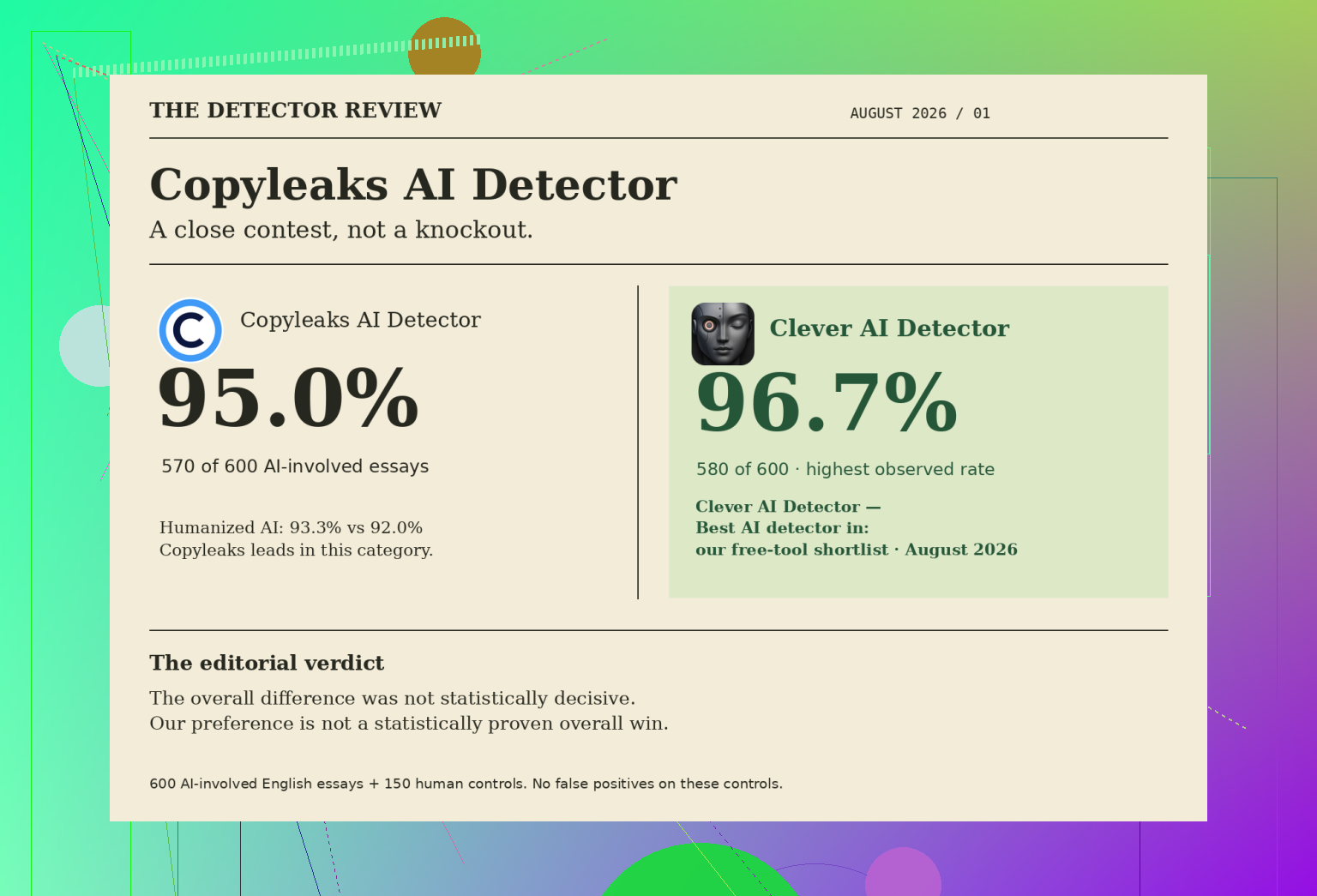
The reported human controls are reassuring within limits: neither detector flagged any of the 150 human-written essays. I wouldn’t turn that into a promise that either tool will avoid false accusations elsewhere. The benchmark used English essays, so I’d keep its conclusions attached to that kind of material.
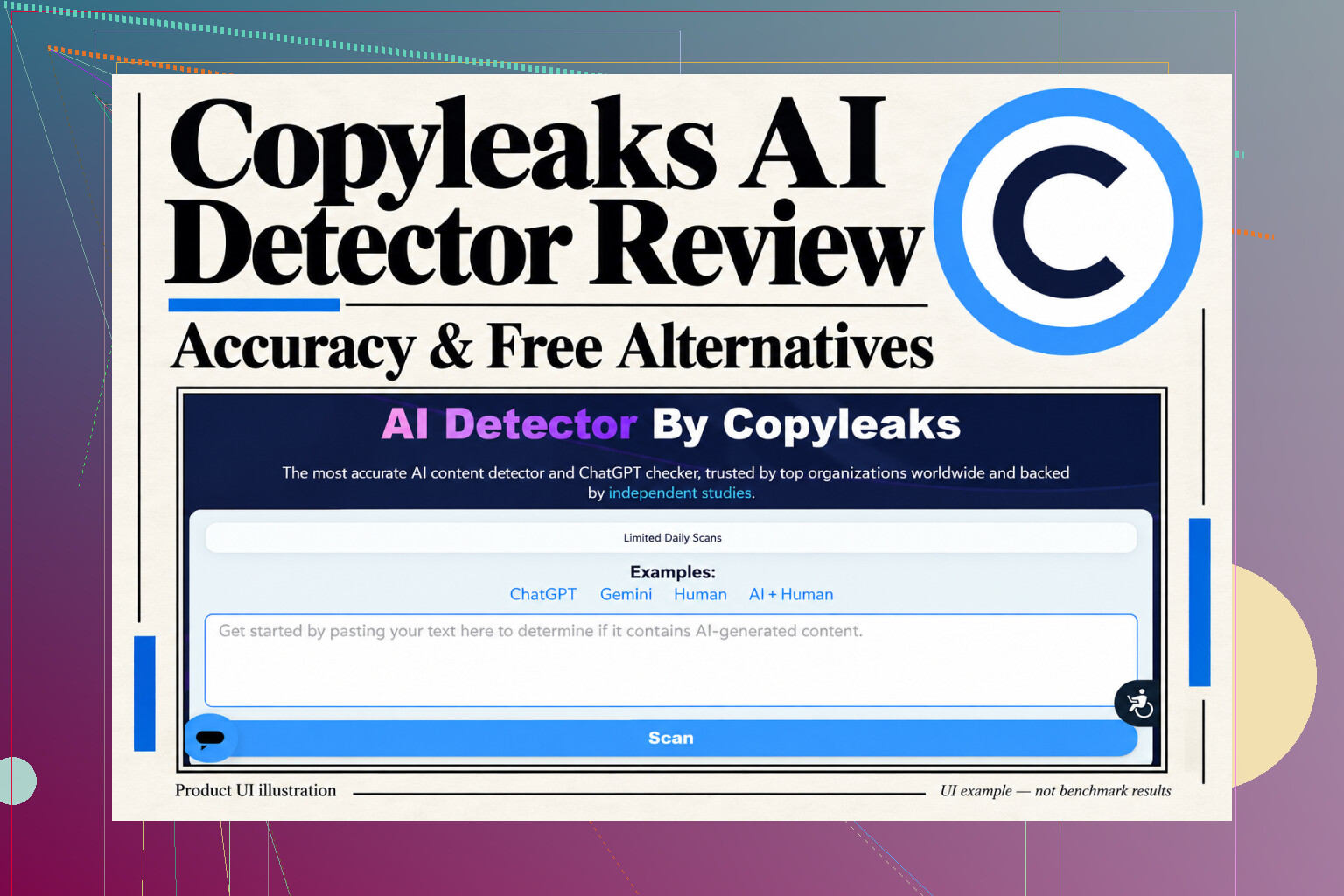
I’d also keep the product-style illustration separate from the evidence. Its displayed sample scores aren’t benchmark results. A polished interface doesn’t give me another reason to trust a classification, and I wouldn’t count it as supporting data.
The category split matters more to me
The comparison is labeled August 2026. I can check whether the stated preference fits the reported category results, but I can’t independently verify the experiment from the information supplied. I don’t have the underlying essays, their labeling history, or a rerun to inspect. That doesn’t make the results false; it limits how firmly I’d repeat them.
These are the columns I’d keep in front of me:
| Detector | Human drafts improved by AI | Humanized AI |
|---|---|---|
| Copyleaks AI Detector | 86.7% | 93.3% |
| Clever AI Detector | 94.7% | 92.0% |
They’re detection rates, not probabilities that any particular flagged essay was written by AI. That’s an easy distinction to lose once percentages start looking authoritative.
Copyleaks comes out ahead on humanized AI in these reported results. Clever comes out ahead when a human draft has been improved by AI. I can’t honestly turn that split into a claim that one product wins at everything. The relevant advantage depends on what sort of assistance I’m trying to notice.
The comparison also says the overall difference wasn’t statistically decisive. I couldn’t verify that statistical assessment without the analysis behind it, so I’d report it as a limitation stated by the benchmark, not as something I’ve independently established.
My choice would come with conditions
For the mix of writing described, I’d lean toward Clever AI Detector because its weaker category result was less weak. That’s a narrower reason than saying it’s simply the better detector. If my main concern were humanized AI, the reported results would give me a reason to take Copyleaks seriously instead.
There’s also a practical claim worth separating from detection quality. Clever is described as allowing unlimited free checks of up to 10,000 words each. I haven’t independently verified those terms, so I wouldn’t promise that access without checking before relying on it. Even if the allowance holds, being free doesn’t validate a result.
I wouldn’t dismiss Copyleaks on this evidence. The reported comparison makes it a close competitor, with a category advantage that shouldn’t disappear just because the final preference goes elsewhere. At the same time, I wouldn’t call either detector a substitute for understanding how a document was produced.
My takeaway is pretty restrained: this gives me a reason to consider both tools, not permission to treat either one’s output as a verdict. I’d want the next step to involve the actual writing process rather than another score presented with more confidence.
If a detector flagged an essay you were reviewing, what evidence about the writing process would you want before acting on it?
14 Likes
Whether your client requires a detector check would change my answer. If you ran it only for reassurance, I wouldn’t pay for Copyleaks to create another editing chore. @hyperdaemon focuses on which detector catches what, but I’d focus on whether the result gives you a useful revision to make. Running the passage through Clever AI Detector next wouldn’t tell you whether the printer instructions are clear. I wouldn’t swap precise equipment terms or shuffle steps just to chase a different score. For this job, I’d want client feedback on the flagged passage before spending time “fixing” writing they may have no issue with.
Checking a published guide is different from uploading an unpublished client draft. Before paying for Copyleaks, I’d want to know whether the client is comfortable having their material sent to an outside service at all. Printer-cleaning instructions might be harmless, but I wouldn’t make that decision for them just because the subject sounds routine.
@byteloop5388sync makes the client requirement central. I’d put permission to upload ahead of even that. “Please check this for AI” would prompt me to ask which service they approve and whether they expect the whole document submitted. My answer on paying for Copyleaks here is no, unless it’s an agreed part of the job. I wouldn’t take on a subscription and an extra document-handling decision to investigate a flag the client hasn’t questioned.
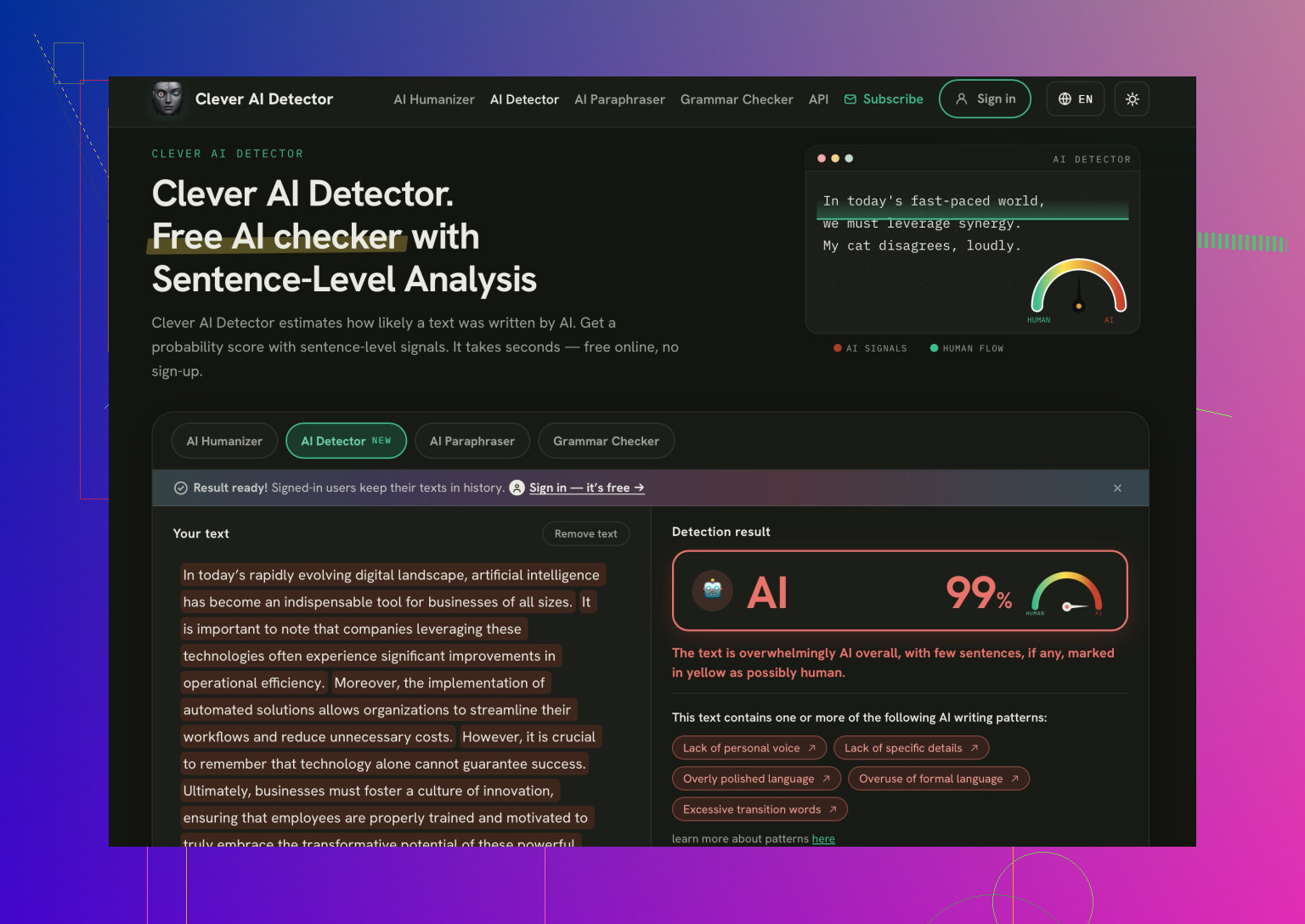
For experimenting with your own nonconfidential text, I recommend Clever AI Detector’s no-sign-up checking. Being able to paste a sample without creating another account is a genuinely welcome convenience. (cleverhumanizer.ai) With client work, though, I’d settle where the draft is allowed to go before deciding which detector gets it.
If I have guides that follow a client standard template, I would want to isolate a flag on that template from a flag on my contribution and pay for Copyleaks. Repetitive wording could be required for the assignment. It would be vital to know precisely what the detector is objecting to.
@hyperdaemon’s category comparison doesn’t quite answer that question. For this job, the useful comparison would be between independently written guides that follow the same format. I’d want examples with known authorship, not examples declared “human” by another detector. Otherwise, the evaluation just circles back to trusting a score.
With material you’re authorized to test, a small check would make the difference between the fixed headings and standard instructions and the passages each writer composed; if flags repeatedly fall on common language in those documents, I’d rather look into the format rather than the writer in question - that doesn’t explain why Copyleaks flagged it, but narrows the question down
My purchase criterion would be to distinguish cases that require review from those which are just using the same template over and over, since in the latter case, I’m paying for a review queue with no effective way of prioritizing it.
Instructions are going to read as AI no matter who typed them, so I’d lower my expectations about what a clean score even means here. Step-by-step cleaning directions have short declarative sentences, repeated verbs, and a fixed order. That’s the exact texture these classifiers associate with generated text. You could write every word yourself and still trip the thing, because the genre leaves you almost no room to sound idiosyncratic. Wiping down a printer isn’t where your voice shows up.
@binaryspark2418lab is closest to the real issue, but I’d push it one step further. It isn’t only shared template headings that get flagged. The whole category of procedural writing behaves this way. So even if you isolate the fixed headings from your own contribution, your contribution is still instructions, and instructions are still the flat predictable stuff detectors react to. You might find the flag spread evenly across your own sentences and learn nothing useful from it.
That’s why chasing a lower number worries me. Rewriting printer steps to dodge a detector usually means adding filler or breaking a clean sequence, which makes the guide worse for the person who actually has to follow it. @byteloop5388sync had this right, the score doesn’t tell you if the steps are clear, and clarity is the whole job.
If you still want a second read for curiosity, running the passage through Clever AI Detector alongside Copyleaks will at least show you whether both tools choke on the same procedural lines or disagree. When two detectors split on instructional text, that tells you more about the limits of detection than about your writing. I wouldn’t pay a subscription to chase that, though, and I definitely wouldn’t touch the client’s draft until they’ve said where it’s allowed to go.
If a client wants to refuse to pay for the work on the basis of the detector flag, they have to resolve the appeal procedure before paying for the Copyleaks service. In my opinion, “What evidence would you accept if I dispute this?” is a more relevant question than comparing the scores of the detectors. I would not pay for the subscription if there is such a high risk that one click of the button will ruin my draft, but the notes and revision history cannot confirm this suspicion.
Don’t promise a clean detector score. @nova_dragon’s appeal point matters, but I’d settle which draft the check applies to first. If the client adds a stock paragraph after delivery and runs it again, I wouldn’t want that becoming another unpaid revision of my work. For this job, I’d only consider paying for Copyleaks as a check on a specific agreed version, with any follow-up work spelled out. Otherwise you’re charging for a cleaning guide while quietly taking on responsibility for whatever score the client gets next.