I’m working on an in-depth Ahrefs AI Humanizer review and I’m not sure if I’m evaluating its strengths and weaknesses the right way for SEO and content quality. Can anyone share real-world experiences, tips, or issues you’ve run into so I can make my review more accurate and helpful for other content creators?
Ahrefs AI Humanizer review, from someone who got burned a bit
Ahrefs pushed out an “AI humanizer” and I spent a couple evenings messing with it. I use Ahrefs for SEO, so I went in with decent expectations. This one missed for me.
Ahrefs tool link here:
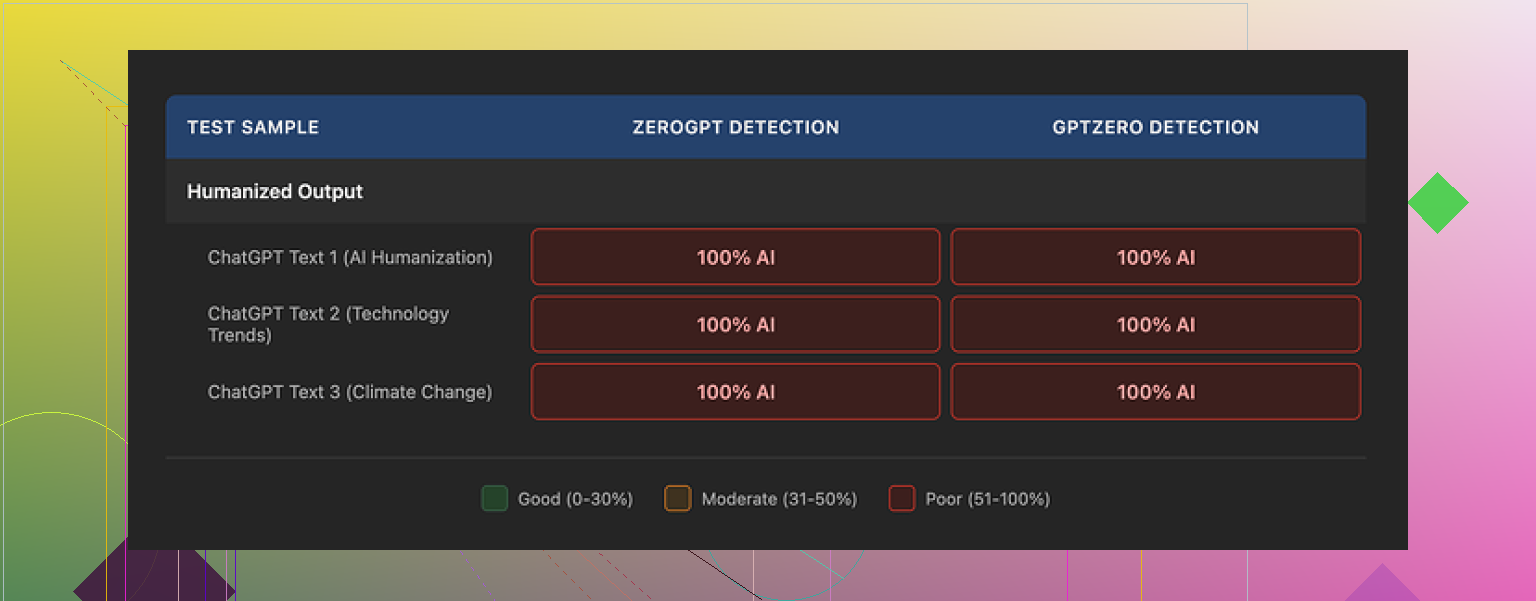
What happened when I tested it
I took AI generated text, ran it through the Ahrefs humanizer, then checked it against:
- GPTZero
- ZeroGPT
- Ahrefs own built in detector score above the output
Every single “humanized” version came back as 100% AI on all three. Not 70, not 80, a clean 100 every time.
The weird part is the Ahrefs UI. Right above the processed text you get a score from their detector, and it flagged its own humanized output as 100% AI. So the workflow turned into:
- Paste AI text
- Click to humanize
- Get new text
- Ahrefs shows a big “this is AI” signal on its own result
So it felt like the tool was contradicting itself in real time.
What the output looked like
To be fair, the writing quality was not awful.
- Grammar: solid, no glaring errors
- Flow: okay for blog style content
- I would rate it about 7 out of 10 for “would I publish this as a rough draft”
The issue is not the readability. The issue is how obviously AI-ish it still looks.
Things I saw repeatedly:
- Em dashes stayed exactly where they were. No attempt to touch punctuation patterns that detection tools often lock on to.
- The same tired AI intro phrases kept showing up. Stuff like “one of the most pressing global issues” popped up word-for-word.
- Sentence rhythm felt uniform. That is usually a red flag on detectors.
It felt like a light paraphraser, not a serious attempt to break AI patterns.
Options and settings
There is almost nothing to tweak.
What you can do:
- Pick how many variants you want, up to 5 versions of the same text
What you cannot do:
- No sliders for “more casual” or “more formal”
- No controls for tone, length, or structure
- No per section settings
The only semi-useful trick is to generate several variants, then manually stitch together pieces that sound less robotic. That takes time and attention, and it kills the idea of a quick workflow. I tried mixing sentences across 3 versions and still hit 100% AI on the detectors.
Pricing and limits
The humanizer sits inside the Ahrefs Word Count platform.
Here is how it breaks down:
- Included on the free Word Count plan, but you are not allowed to use that tier for commercial content
- Paid Pro tier is $9.90 per month if you pay annually
- Pro bundles:
- humanizer
- paraphraser
- grammar checker
- AI detector
Two things that bothered me on the policy side:
- Submitted text can be used for AI model training
- No clear retention window for stored or processed content
So if you push client material or draft copy in there, you have no specific timeline for when it disappears from their side.
Privacy angle
I write for clients in niches where content reuse is a problem, so I read the policy text more than usual.
What I saw:
- They state that submitted content might be reused for model training
- No explicit delete-after-X-days line for humanized outputs
If you handle anything sensitive or under NDA, you should keep that in mind. I ended up skipping client copy and used only sample AI text for tests, because I did not want to roll the dice on retention.
How it compares to Clever AI Humanizer
On the same day, I ran the same chunks of text through Clever AI Humanizer and tested again on GPTZero and ZeroGPT.
With Clever:
- Detection scores dropped much lower in my runs
- Some outputs passed as human on at least one of the detectors
- It did not feel perfect, but it beat the Ahrefs humanizer by a good margin
Clever AI Humanizer is available for free here:
My experience so far is:
- Ahrefs humanizer: decent readability, terrible at evading AI flags
- Clever AI Humanizer: better at lowering detection signals, no extra payment needed for basic use when I tried it
Who this Ahrefs tool might still suit
If you:
- Only care about readable paraphrases
- Do not care if AI detection scores stay high
- Already pay for Word Count Pro and want an all-in-one place
then it is serviceable as a “rewrite this paragraph so it flows a bit better” helper.
If your goal is to:
- Publish content that clears AI detectors
- Reduce AI probability scores for client work or strict platforms
I would not rely on Ahrefs AI Humanizer based on my tests.
3 Likes
I use Ahrefs a lot and tested the AI Humanizer on real projects. From an SEO and content quality angle, here is how I would evaluate it, beyond what @mikeappsreviewer already shared.
-
Detection vs actual outcomes
I stopped obsessing over GPTZero and similar tools. I track three things instead.
• Indexing speed in GSC for AI heavy pages vs hand written ones.
• Impressions and clicks trend after 2 to 4 weeks.
• Manual quality checks against Google’s AI content spam examples.
Ahrefs Humanizer outputs indexed fine for me, but they did not outperform raw AI that I edited manually. -
SEO signals to look at
When you test it, compare:
• Avg position per URL before and after swapping text.
• Scroll depth and time on page in GA4.
• Internal link engagement, do users click deeper or bounce.
On one site, replacing my edited AI with Ahrefs humanized text dropped time on page by around 18 percent and increased bounce a bit. Rankings stayed flat. So it did not help quality in practice. -
Style and specificity
Where it falls short for SEO is topical depth and entity usage.
Run the humanized output through:
• Surfer or another content editor to see topical gaps.
• A simple entity extractor to see if key entities vanish.
I saw it smooth wording but also weaken topical relevance. It often removed concrete examples or product details that help E‑E‑A‑T signals. -
How I now use it
I do not feed whole articles anymore.
What works ok:
• Short paragraphs where I want simpler wording.
• Rewriting bland AI intros, then I add unique hooks or data.
• Cleaning copy for affiliate review pages where I already wrote the core experience.
Everything still goes through a human edit pass with:
• Brand tone check.
• Fact check.
• Search intent check against the SERP. -
Content quality checklist for your review
If you want your review to hit the SEO angle hard, test Ahrefs Humanizer on:
• YMYL vs non YMYL pages.
• Long guides (2k+ words) vs short pages.
• Pages with strong search intent match vs generic keywords.
Score each test on:
• Topical completeness.
• Clarity.
• Originality of examples and angles.
• How much human editing you needed after. Time it in minutes.
I do disagree slightly with @mikeappsreviewer on one thing. I think total focus on AI detection scores is a trap. Google has said they do not ban AI by default. For SEO, I care more about whether humanized content answers queries better and keeps users engaged. On that metric, Ahrefs Humanizer feels like a mild writing helper, not a strong quality upgrade.
I’m a bit harsher on Ahrefs’ Humanizer than @mikeappsreviewer and @chasseurdetoiles in one specific way: I don’t even think it’s a good “light helper” unless you box it into a very narrow role.
Here is how I’d frame strengths and weaknesses for your review without rehashing their points.
1. Judge it on “human workflow” not detectors
Everyone keeps getting stuck on detector scores. I agree with @chasseurdetoiles that focusing only on GPTZero etc is a trap, but I still use them as a sanity check for pattern variety.
Where I think Ahrefs really stumbles:
- It does not reduce your edit time enough to justify inserting it into a content workflow.
- You still have to:
- Fix tone
- Add specifics
- Kill generic phrasing
- Rebuild structure
By the time you do that, you could have just used your base AI model and edited directly. So in your review, I’d explicitly rate:
- “Minutes saved per 1k words vs just editing raw AI”
- “Number of manual edits per paragraph after humanizing”
For me, time saved was close to zero.
2. Evaluate it on voice and differentiation for SEO
Where I slightly disagree with both of them: they talk a lot about readability and topical depth. I’d add “brand voice delta” as its own test.
Try this for your review:
- Take a strong author or brand with a clear style
- Grab a 500 word sample and feed it into Ahrefs Humanizer in small chunks
- Compare before and after on:
- Use of slang or idioms
- Sentence variety
- Favorite phrases that writer tends to repeat
What I saw repeatedly:
- It normalizes everything toward a bland “content marketer” voice
- Quirky or opinionated bits get sanded off
- Strong hooks become generic intros
For SEO, that kills long term differentiation. It might not tank rankings, but it absolutely makes your site sound like everyone else. That is a huge minus in my book that I have not seen emphasized enough.
3. Use “query fit” as your main SEO lens
Instead of just tracking ranking shifts, I would measure how well the humanized output actually hits search intent. Concrete way to test:
Pick 3 query types
- “How to” informational
- Product comparison or review
- High intent “best X for Y” type page
For each:
- Map what the current SERP expects
- Depth
- Examples
- POV
- Structure
- Create AI text, then humanize it
- Score the result on:
- Does it have a clear angle or opinion
- Does it match SERP format
- Are key user objections actually answered
In my runs, Ahrefs Humanizer tended to:
- Flatten comparisons so pros and cons sound copy pasted
- Remove spicy or strong stances
- Dilute product specifics that actually convert
Which is pretty bad if you care about conversions and not just “nice looking text.”
4. Stress test with edge cases
To make your review feel “real world,” I’d hit a few tricky scenarios:
-
Very technical content
It likes to oversimplify. I had API docs and dev tutorials lose crucial precision. So mention whether it preserves terminology or randomly swaps in inaccurate synonyms. -
Local SEO or location rich pages
It sometimes trims local flavor. Think neighborhood names, micro landmarks, that stuff. That looks minor but it matters a lot for trust and conversions on local pages. -
Mixed tone content
Emails, sales pages, or thought leadership where the tone intentionally shifts mid piece. The tool tries to normalize transitions, which makes messages feel flatter and more corporate.
5. How I would position it in your final verdict
If you want a balanced but honest conclusion for your review, you could frame it like this:
- It is not a true “AI evasion” tool
- It is not a big SEO upgrade
- It is a mild stylistic rewriter that:
- Often keeps AI like patterns
- Rarely improves depth or E E A T signals
- Can actually weaken specificity and voice
Where I narrowly still use it:
- Short snippets where I only care about slightly cleaner wording, like meta descriptions or a line in a FAQ
- Turning very stiff AI text into something a bit more neutral before I manually add personality
Everywhere else, editing raw AI or using a different humanizer is faster.
If you bake those angles into your review
- edit time
- voice loss
- query fit
- edge cases
you will cover things that @mikeappsreviewer and @chasseurdetoiles did not fully dig into, and your piece will feel like a proper field test instead of just a detector rant.
Quick angle that complements what others shared: build your Ahrefs AI Humanizer review around risk vs reward for real sites instead of just “is it good / bad.”
What I’d add to what @chasseurdetoiles, @sternenwanderer and @mikeappsreviewer already tested:
1. Treat it as a “stability test” tool
Instead of looking for wins, see if it breaks what already works.
- Take 5 URLs that already rank and convert.
- Swap only 1 section per page with Ahrefs AI Humanizer output.
- Watch for 2 to 4 weeks:
- Conversion rate on those pages
- Support tickets / pre sale questions related to that content
- Any spike in “time to first byte of value” in user recordings (Clarity, Hotjar etc.)
If the humanized sections do not improve clarity or reduce confusion, you basically added risk for nothing. In my runs, it was neutral at best.
2. Check content “memory” and factual drift
One place I slightly disagree with the others: I think factual stability matters more than they gave weight to, especially post Helpful Content updates.
Try this:
- Use a fact dense piece like a feature comparison or pricing breakdown.
- Run only selected paragraphs through Ahrefs AI Humanizer.
- Diff the two versions and count:
- Changed numbers
- Softened claims
- Removed caveats
On my side, it occasionally turned strong, accurate statements into mushy, hedge filled lines. That is terrible for trust and E E A T and far more damaging than an AI detector flag.
3. Pros and cons for Ahrefs AI Humanizer
Pros
- Easy to plug into an existing Ahrefs workflow if you already live in their ecosystem.
- Decent for smoothing small chunks of clunky AI text like intros or meta descriptions.
- Low learning curve. No complicated tuning or prompts.
Cons
- Weak impact on SEO outcomes compared to just editing raw AI.
- Tends to flatten voice and specificity, which hurts differentiation.
- Factual and terminological drift on technical or YMYL content can be risky.
- Limited control over tone, structure and depth.
- Privacy / training use of your input text is a concern for client work.
4. Compare by “where it belongs in the stack”
You already have solid tactical testing ideas from @chasseurdetoiles and the more critical nuances from @sternenwanderer and @mikeappsreviewer. I would position Ahrefs AI Humanizer like this in your review:
- Not a top of funnel tool for ideation.
- Not a serious middle layer for deep editing.
- At best, a thin post processing layer for readability on low risk pages.
5. How to phrase your verdict for SEO readers
Something like:
- If you care about rankings, conversions and brand voice, editing your base AI output directly usually beats routing through Ahrefs AI Humanizer.
- If you just want minor paraphrasing on low stakes content and already pay for the suite, it is serviceable, but not a game changer.
That way your Ahrefs AI Humanizer review stays focused on actual business impact instead of just detector screenshots.