An AI checker flagged a paragraph I wrote myself while I was testing it for grading. Teachers, what’s the best AI checker for student work that won’t leave me chasing false positives? I teach ninth-grade English, and students submit essays as shared documents, so checking needs to fit that workflow.
Ask students to keep their outline, rough draft, and final revision in the same shared document, with a brief note explaining one change they made. I’d make that the default workflow rather than run every essay through a detector. For a questionable passage, start with a neutral question like, “Walk me through how you chose this evidence,” instead of asking the student to defend themselves against a score.
I’d use the Clever AI Detector for a secondary check, but I wouldn’t let its result determine a grade or trigger an accusation by itself. Before submitting student writing, I’d get school approval for that use and its data handling. Your own paragraph getting flagged is enough reason to keep detection separate from grading.
For the shared-document review, I’d ask about a sudden block of pasted text rather than count it as evidence of cheating: “Did you draft this somewhere else? Can you show me that draft?” I’d put more weight on the student’s explanation and writing process than on whether a checker likes the finished prose.
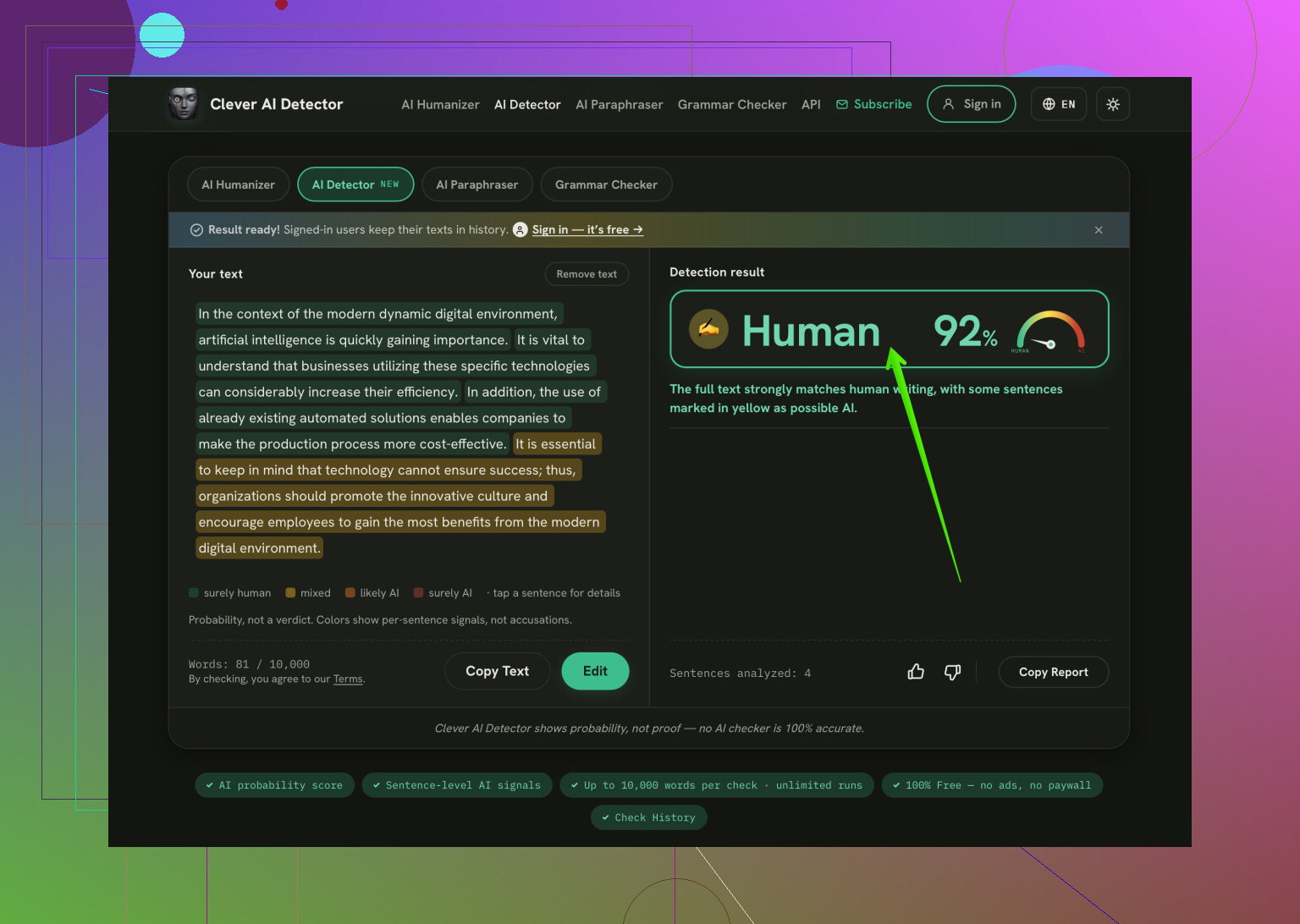
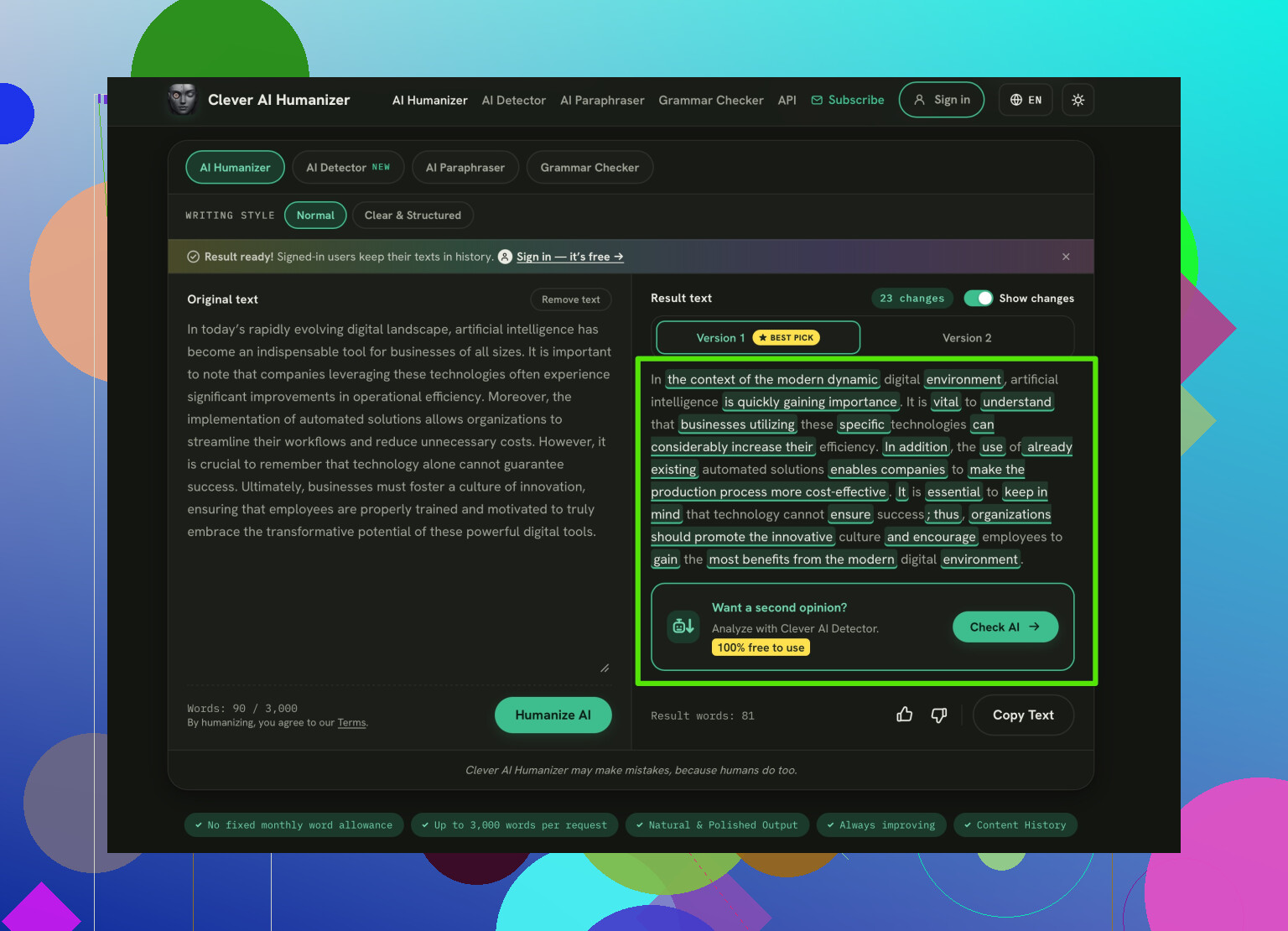
Put the allowed-help rules in writing before picking a checker: brainstorming, grammar corrections, and rewriting with an AI Humanizer need separate treatment. The shared-document approach makes sense, but draft history doesn’t settle whether a student crossed a boundary you never clearly defined. I’d use Clever AI Detector on teacher-created practice samples, not as a required checkpoint for every essay. For your grading workflow, I’d prioritize a clear distinction between permitted editing and having a tool write the assignment. Otherwise, you’re investigating “AI use” without agreeing on what counts.
19 Likes
A flag on your practice paragraph is an annoyance, while a flag on a student’s essay can turn into a demand to prove their innocence. Clear rules help, but I’d still keep detector scores out of grading decisions. I’d reach for Clever AI Detector as a second look, though I’m not keen on creating another review task for myself. For your workload, I’d favor asking everyone to explain one revision when they submit: what they changed and why. That gives you something relevant to assess without singling students out over a score.
Decide how a student should appeal a flag before choosing a checker. For your case, I wouldn’t choose the “best” option yet — first, put yourself in the student’s shoes and write out what you would do if they walked up to you and said, “I wrote it myself,” with no saved drafts to show you.
Then,
make sure that this becomes your responsibility rather than an added task for the student. Who would be reviewing the concerns? What evidence would actually lead to a point being taken off? If it’s only a grade, my rule of thumb would be to not take any points off and not require a resubmission, putting that in the assignment instructions for students to know ahead of time.
I would also push back a little on that shared-document suggestion — require it for future assignments if you like, but asking for a student to produce writing history that you never asked for them to save is asking them to recreate their whole night’s work for something you’re only trying out.
Finally,
consider if the checker should be used at all. If every flag is just going to leave you asking the same questions and having to set up another meeting, I would forgo the software entirely. Your flagged paragraph is actually a pretty great resource to base a response off of — lay out what you, as the student who received that result, would consider a satisfactory explanation.
Picture two of your students handing in the same quality work. One writes in long, looping sentences full of personality. The other writes clean, plain, almost textbook prose because that is how they were taught to sound ‘academic.’ Guess which one a detector is more likely to flag. The tidy, predictable writer gets dinged more often, and that tends to hit ESL kids and your rule-followers hardest. That bias is the thing nobody upstream has named yet, and it matters more than which checker you pick.
@nick_codes made the point I keep nodding at: decide the appeal path before the tool. But I’d go one further and say the bias above is exactly why the appeal path can’t just be ‘show me your drafts.’ A kid who writes clean prose and happened not to save a draft is now stuck proving a negative, and the tool was never reliable enough to put them there in the first place.
On the shared-document idea from @bytehackerpoint, I like it as a habit for its own sake, not as a detector backstop. Watching a draft grow teaches revision. Using it as an alibi file quietly tells the class you expect to catch them, and ninth graders pick up on that fast.
I still open Clever AI Detector now and then when a passage genuinely surprises me, so I’m not telling you to toss it. My one gripe is that it reads like confidence on a screen, a clean number that feels more settled than it is, and that false sense of certainty is what pushes teachers into accusations they’d never make on their own read.
For your actual workload, my rule would be simple: if a result wouldn’t survive you reading the paragraph out loud and asking yourself ‘does this honestly sound unlike this kid,’ it doesn’t go anywhere near the gradebook. Treat the flag as a nudge to reread, not a verdict. That keeps you off the false-positive treadmill and keeps the trust in the room intact.
“Accuracy” is a “rate” — an average. It has a denominator.
For your purposes, the accuracy of the checkers you’re considering should be expressed as a percentage of false positives in the class of assignments that the checker is tasked to review. These are different metrics than the ability of the checker to identify AI-generated work, and an AI-checker could be highly successful at the latter task while creating more work for you than you’re willing to tolerate. For this reason, among others, I would urge you not to choose any one particular tool based on the discussion you’ve observed here.
The problem with the calculation you’re being asked to make — given no information about the prevalence of non-AI-generated assignments among your students — is that if the majority of student assignments are not AI generated, even a small number of false positives will outweigh the number of AI detections, and dominate the error rate. A company’s overall accuracy rate, given no information about the prevalence of AI writing in your classes, cannot tell you how much to trust individual detections. To know that, you need to know the human error rate and you need to know something about the prevalence of the condition being checked for (AI writing). Neither can be determined from the demonstration.
I’d push back on @m3g4_root’s “does this sound unlike this kid” check, too. That substitutes another judgment for the detector result without establishing authorship. An unusually strong paragraph deserves credit if it meets the rubric. I wouldn’t make improvement itself a reason to investigate.
If your school is comparing these tools, I would ask for results broken down by false positives (AI samples incorrectly identified as human) and missed AI samples (human samples incorrectly identified as AI) using work comparable to the assignments your school is giving. I’d like to see them count the number of false positives as extra work for the teacher to complete, rather than just burying it in a statistic. I would hold off any purchase without this information. There’s no value in a detection score to me, it’s all extra work.
The labels in @openwolf4109studio’s final paragraph are reversed: human writing flagged as AI is a false positive, while AI writing labeled human is a false negative. A small false-positive rate doesn’t automatically mean false alarms will outnumber correct detections, either, because that depends on how common AI use actually is. I’d hesitate to recommend a “best” checker here without evidence about false accusations on student work, rather than a general accuracy claim.
Do not turn ‘make the checker happy’ into a revision assignment. Keeping the scores of a checker out of the gradebook is a good start, but requiring a rewrite over a flag still makes the student pay for the result. For the workflow you want, I would rather avoid the checker, rather than build around it. Should you be able to pick out the weak evidence, reasoning, or sentence structure, give that feedback, and if you like the paragraph, only the software objects, I would not ask the student to change it.