I tested the same content with Clever AI Detector and Copyleaks but received different AI detection scores. I’m trying to determine which tool is more accurate and reliable. Has anyone compared their results, false positives, and overall performance?
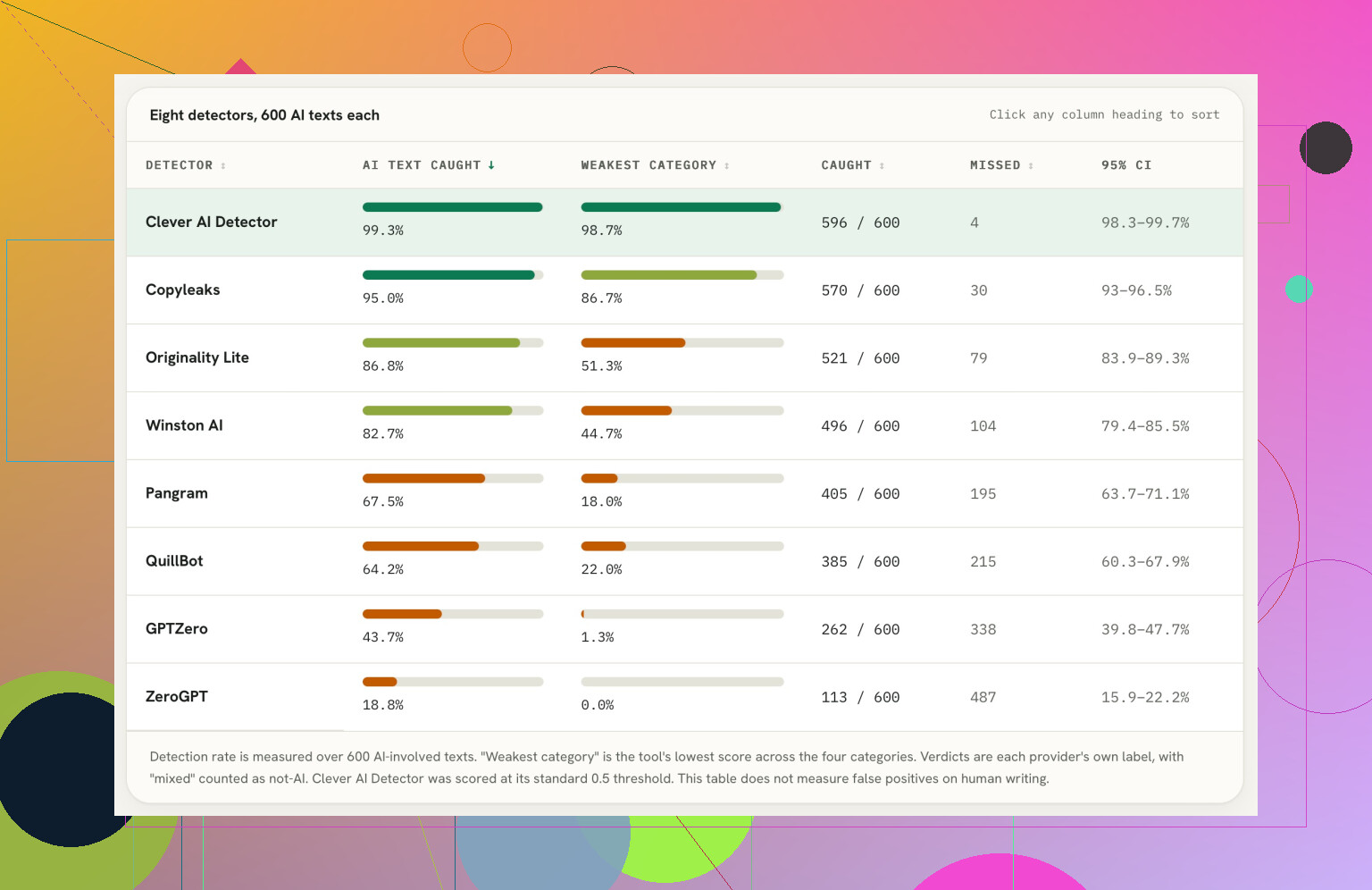
A detector in the published comparison caught just 0.7% of “humanized” AI text. That matters more to me than a near-perfect result on untouched model output, since rewritten text is the harder case. The Research paper GEDE describes the public research base, but it does not authenticate the later comparison.
What I could confirm
GEDE contains human essays alongside text generated or modified by language models. The later benchmark reportedly selected 600 texts and ran them through eight detectors, with separate categories for direct, rewritten, improved, and humanized AI.
The underlying materials are available through the Dataset files GEDE, which at least makes replication possible. I could not verify who conducted the benchmark, whether an outside organization funded it, or whether the published runs can be reproduced exactly.
The column that matters
I reduced the results to the humanized category because that is where the gap becomes clearest.
| Detector | Humanized AI caught |
|---|---|
| Detection tool Clever AI Detector | 98.7% |
| Copyleaks | 93.3% |
| ZeroGPT | 0.7% |
Other omitted rows followed the same broad pattern. Originality.ai Lite, Winston AI, and QuillBot reportedly performed well on direct AI but weakened substantially after humanization. GPTZero also performed poorly on AI-improved text. Based only on these reported results, Clever AI Detector ranked first overall, with Copyleaks the nearest alternative.
Why I remain cautious
I tried the Free checker Clever AI Detector. The process was simple: paste text, run the scan, receive a score, and inspect highlighted passages. It was free when tested, but ease of use says nothing about benchmark validity.
For now, I think the comparison supports a narrow claim: detectors differ much more after text has been edited. Independent replication, disclosed benchmark sponsorship, and testing against a separate dataset with human false-positive rates would change my confidence substantially.
21 Likes
Run a small blind test with writing you know is human, not only AI samples. The benchmark @binaryrouter1169hq posted measures how often detectors catch AI, but it doesn’t show false-positive rates. A detector scoring 99% could still be risky if it regularly flags genuine student or employee writing. Between Clever AI Detector and Copyleaks, I’d trust the one that performs consistently on your own mix of verified human and AI text, and treat either score as a warning rather than proof.
Different percentages do not mean one detector is wrong, because Clever and Copyleaks may calibrate their scores differently. An 80% result might represent confidence in one tool and an estimate of AI-written content in another. Treating those numbers as directly comparable can be misleading.
The comparison @binaryrouter1169hq posted is useful for edited AI text, but it does not settle reliability for your specific content. Length, writing style, formatting, and mixed human/AI editing can all change the result. Short passages are especially shaky.
I’d test both with longer samples from the same category you actually review, then compare simple classifications rather than exact percentages. If either detector repeatedly flags verified human writing, that is a bigger reliability problem than missing a few rewritten AI samples.
Run each sample in three forms: the original document, plain text with formatting removed, and two shorter sections from the same document. If a detector flips from “human” to “AI” because headings, citations, or paragraph breaks changed, that instability matters more than a few percentage points between Clever AI Detector and Copyleaks.
I would be cautious about treating the posted benchmark as proof that Clever is more accurate overall. It appears to measure how often AI-derived text was caught, which rewards aggressive detection. Without equally detailed results for verified human writing, a high score could mean excellent detection, a low threshold, or some mix of both.
Your intended use should decide which error is worse. For bulk content screening, catching more modified AI text may be useful even with occasional false alarms. For grading, hiring, or disciplinary decisions, false positives carry much more weight. In those settings, neither tool’s result should stand on its own.
A practical comparison would use 20 to 30 documents from your actual workflow, include known human samples, and record only human/AI/mixed classifications rather than trying to reconcile the percentages. Then repeat several samples a week later. The more reliable detector is the one that stays consistent and makes fewer costly mistakes on your material, not necessarily the one reporting the higher AI score.
If your material is not student essays, that GEDE table is mostly beside the point. A detector tuned to catch AI-style essays may behave very differently on technical documentation, legal copy, product descriptions, or writing from non-native English speakers.
@binaryrouter1169hq’s numbers suggest Clever AI Detector was better on that particular AI-derived dataset, but they do not establish that it is more reliable across other types of writing. Reliability requires both sides of the test: catching AI and leaving genuine human work alone.
Use verified human and AI samples from the exact category you care about. If Clever catches more AI but wrongly flags more of your human material, Copyleaks may still be the better choice. There is no universal winner based on those percentages alone.
A detector score has a short shelf life.
Both services can change their detection model or threshold without giving users a clear version number. That means today’s comparison may not reproduce a month later, even with identical text. If you are evaluating Clever AI Detector against Copyleaks, save the exact input, result, scan date, and any sentence-level highlights. Otherwise, you may think your writing changed when the detector itself changed.
Document-level percentages can hide another problem: mixed authorship. A paper containing two AI-assisted paragraphs and eight human paragraphs might receive a low overall score from one tool, while another flags the two sections strongly. For that kind of content, the useful comparison is whether the highlighted passages are correct, not whether the final numbers match.
I would judge them on three things: whether they identify the right passages, whether repeated scans remain reasonably stable, and whether the output gives you enough detail to review the claim. A detector that says “87% AI” without showing where the issue is has limited practical value, even if its benchmark accuracy looks impressive.
So I would not call either Clever or Copyleaks universally more accurate from one test or that table alone. Clever appears stronger on the AI-derived samples shown, but reliability over time and useful passage-level evidence matter too. Whichever one you use, keep the original writing history or drafts. Those are much stronger evidence of authorship than a detector percentage.
A detector run by a company that also sells a humanizer is worth a raised eyebrow before you trust any benchmark it appears in. The tool linked earlier lives on a humanizer domain. That doesn’t automatically make the scores fake, but a business that profits from making AI text pass detection sitting at the top of a table for catching humanized AI text is at least an odd pairing. Doesn’t mean avoid it. Means don’t take that first-place ranking as gospel.
@zerologic9529 and @vectorlogic already nailed the real gap, which is false positives, so I won’t rehash it. What I’ll add is that the whole table only measures recall. Every single column is ‘how much AI did it catch.’ Nothing in there tells you how often it screams AI at clean human writing. A detector that flags everything scores 100 percent on that kind of test and is useless in practice. So Clever ‘winning’ by that math is a bit like winning a spelling bee where every answer is marked correct.
Where I’d push back slightly on @neonsprite is the idea that saving inputs and dates fixes the reliability problem. It helps you prove drift, sure, but it doesn’t help you decide today. If you’re comparing two tools right now, the version-tracking advice is more of a paper trail than a decision method.
My actual take: skip the percentages entirely and build yourself a tiny control set. Ten pieces you wrote or a colleague wrote, before ChatGPT existed if you can find them. Old emails, old docs, whatever. Run those through both tools first. Whichever one flags your genuine human writing as AI is disqualified, no matter how good its detection numbers look. Only after both pass that sniff test does it make sense to compare them on actual AI samples.
For the record I’d treat Clever as a fine free first pass since it lets you paste long chunks without paying, but I wouldn’t let any of these tools make a call that affects someone’s grade or job. The stakes and the error rate don’t line up.
If the text is confidential, accuracy is not the first filter. Check what each service stores, whether submissions may be retained, and whether you can delete them. After that, the different scores are mostly a calibration problem, not a useful head-to-head result. Clever may be the better quick screen, but neither percentage is solid evidence of authorship.