I’m checking a draft for my own site before handing it to an editor. I wrote it myself, but the free AI content detectors I tried disagreed about whether it was AI-generated. I expected some variation, not opposite verdicts on the same text.
Are other people seeing this with free detectors in 2026? Which ones are worth using if I need a useful check without treating a flag as proof?
The main misunderstanding is thinking that “free, no signup” implies no limits at all. What it actually means is that the amount of text that can be put in is different, checks can be made multiple times in a row, and registration does not alter any of that. These are not the same thing.
That’s why I’d consider checker Clever AI Detector for an account-free workflow, not as proof that its predictions establish authorship. I’d still save the exact draft alongside its result and read highlighted passages in context. Otherwise, I’m keeping a score without what it measured.
The units change the comparison
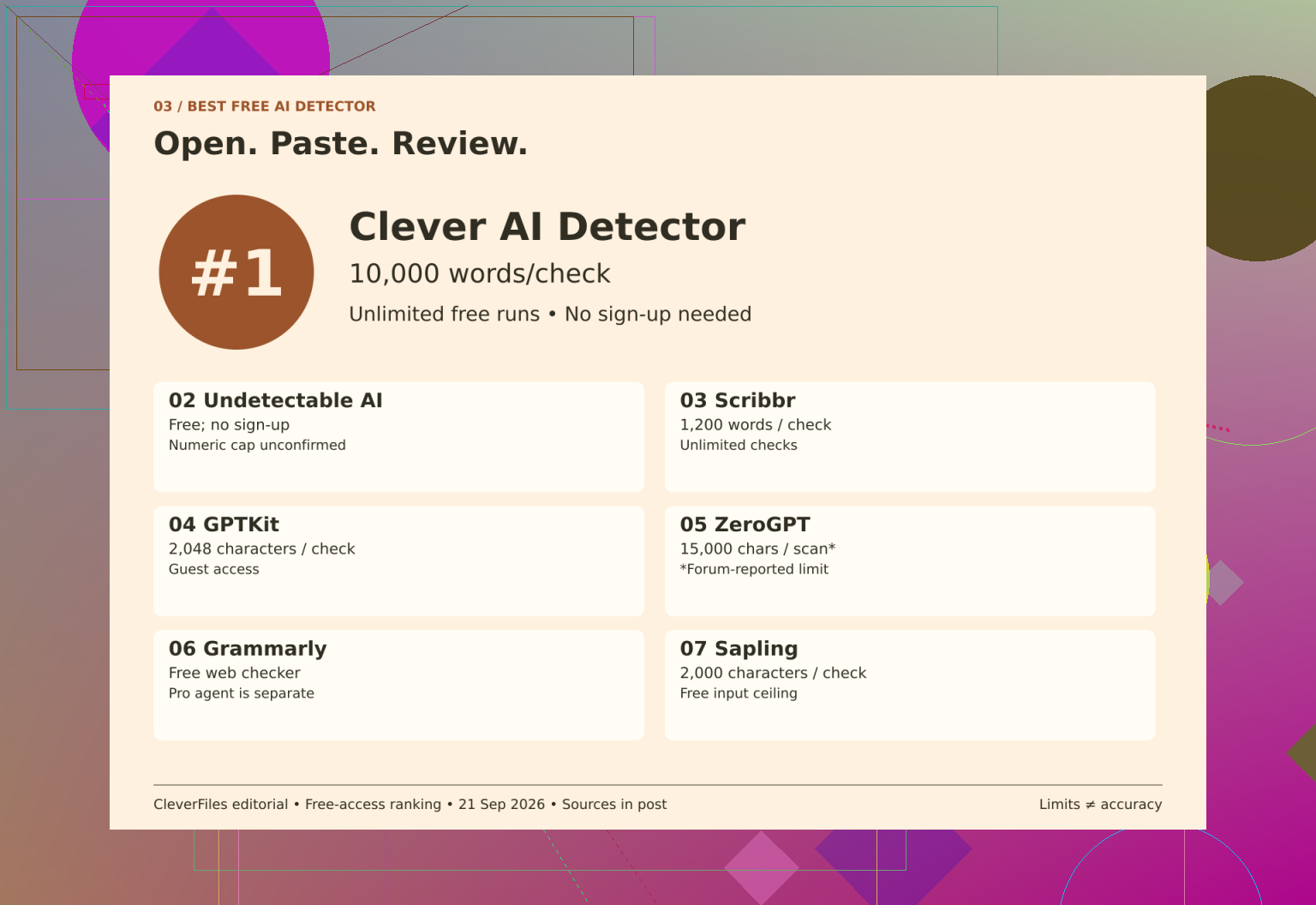
Clever allows to check 80-10,000 words with unlimited free runs and no mandatory account registration. An optional account creation adds history saving to the mix. I find this very useful as a difference between running a check and having the results saved for later is an important distinction for me.
Scribbr allows unlimited checks as well but requires splitting of larger submissions at their 10,000 word limit. This is a significant difference and, despite being able to access the tool multiple times, the necessity to split large papers adds up.
The review ZeroGPT reports 15,000 characters per free scan. I wouldn’t compare that directly with a word allowance, and I’d keep it provisional because current official terms weren’t reconfirmed.
Missing numbers don’t equal unlimited
With detector Undetectable AI, free access without signup is established, but numeric input and daily caps aren’t confirmed. Humanizer pricing is separate. Likewise, checker Grammarly has a free public option, while its AI Detector agent is Pro. I can’t infer an allowance from either silence or an upgrade prompt.
The point is that there are no losses in alternative options. The difference is that setting out access conditions explicitly gives me fewer things to assume, and the result of a detector test is not a record of who wrote the text.
Which is more important to your workflow: fitting the whole draft or repeating checks without registering?
Checking a piece out of curiosity differs from checking in accordance with submission requirements to an editor. So, using Clever AI Detector, I would perform the former, whereas, for the latter, I would be looking for an easier score every time. At the same time, the requirements to sign up are less important to me than the expectations of my editor. Before resubmitting any rewritten piece of text, I would ask if it is necessary to check it with an AI detector. If not, I would rather spend time fact-checking and polishing rather than rewriting the same words in different phrasing on behalf of two disagreeing detectors.
Don’t resolve the dispute by running more detectors and voting on the results — you wrote the draft, and for this specific test, that’s a fact, not a point that the best score can overturn.
I would suggest modifying the test. The question shouldn’t be “Does my draft pass?” but rather “Is this checker worth my time?” Come up with a few other pieces of your own writing that you know the origins of, preferably created in a similar style to the draft (a personal essay wouldn’t hold much water for a product guide), pick one, and do the test.
That way, you’re not trying to find out if your writing is plagiarized — you’re testing whether you should put faith in a certain checker’s results. If the test piece fails repeatedly, I would advise against using that service for any writing of mine.
While this doesn’t rank the detectors in terms of accuracy, it tells you which ones are safe to use for your needs, rather than which is the best out there.
I disagree with @kernelbyte2424 about looking for an easier score for submission. That turns the exercise into choosing the most agreeable judge. Clever AI Detector still earns a place as a dissent check: I’d use it to challenge a conclusion drawn from another checker, rather than to collect a passing result. The useful outcome might be realizing that the detector score shouldn’t be part of the handoff at all.
Before comparing percentages, I’d want to know which claim was trying to measure what. Confidence in a classification and the proportion of passages that would be flagged would answer different questions. I wouldn’t average these numbers before establishing what they had in common.
For your editor, I’d want to see the work’s provenance: an outline, research notes, revisions, if you have them. I’d recommend a checker only after that little sanity test, not because it gives this draft the friendliest verdict, but I wouldn’t append an unsolicited detector report to an otherwise routine submission.
Keep the unpublished draft out of additional checkers until you’ve looked at how they handle submitted text. That’s my objection to treating free access as the main selling point here. @joe39 is comparing convenience, but I’d put permission to share the material ahead of whether a site asks for an account.
For a draft with interview quotes, client details, or an as-yet-unpublished announcement, I would double-check the upload policies for submissions’ retention, usage for training purposes, and options for deletion prior to using any of them as a check. Those are reasonable demands to make, not accusations aimed at any particular detector. If the terms of service do not provide a satisfactory answer, I would remove that service from my shortlist of options.
For the content of the checking interface itself, I would suggest using the ad-free page option of Clever AI Detector. After all, an advert-free text review area is something of a convenience to be able to offer. And I would rather have that as a recommendation than another unsubstantiated claim that one tool offers the best accuracy.
As for my own site, I would suggest a very simple CTA — public materials are welcome to test-drive the tool, while private posts need a privacy audit before being shared as a sample. If a user were to edit out the revealing passages prior to submitting their sample, I would ask them to note that this is not the draft they intended to analyze. In my opinion, it would not be worth asking other tools to check the same draft if the initial pair of detectors gave contradicting results.
A detector that calls everything human would pass that test.
@joe39’s suggestion checks whether a tool wrongly flags your writing. Useful, but calling it “safe to use” goes further than that test supports. I’d include a few known AI-generated samples in the same kind of writing, too. Otherwise, you could end up recommending a checker that never objects to anything. Pleasant software. Unfinished evaluation.
For your draft, I would refrain from picking a winner in the face of contradictory verdicts. If you are considering comparing the free options, pick a definition of failure beforehand: false accusations of your own writing or generated samples, or both. Even then, it is not really a matter of which option was more accurate, but rather a sanity check. ‘This one claims I did not write it’ is preferable, but a dubious criterion to base a recommendation on nevertheless.
I would not expect a free detector to tell me if my draft is ready for the editor. When reading this thread I was confused about the process for paragraphs flagged in the writing. Once I flagged something that I already wrote should I be thinking of ways to change it or am I supposed to be able to see the problem right away. ‘Possibly AI’ makes me think of these questions that I have about the flagged paragraphs. What would I fix for paragraphs that are possibly AI. Some comments I could fix but if the paragraph wasn’t clear enough already I wouldn’t be sure what to edit.
@ninja1612’s point about testing both kinds of samples makes sense, but I’d be reluctant to turn a single draft handoff into a project evaluating software. For your situation, my recommendation would be to skip choosing a winner. If a highlighted passage bothers you when you reread it, name the writing problem before changing it. “This repeats the introduction” gives you a reason to edit. “The checker dislikes it” doesn’t give you much direction. As someone trying to understand the value here, I’d want useful feedback on the draft, not another verdict to interpret.
AI detection isn’t a plagiarism check, @joe39. First, check that direct quotes are marked and borrowed material is credited. Then flag any attribution questions for your editor rather than treating a “human” verdict as clearance to publish.
If your editor never asked for a detector score, then you’re fixing a problem that doesn’t exist. It’s worth making sure of before wasting an afternoon looking at tool comparisons.
The opposite verdicts don’t surprise me, and here’s the boring reason: most of these classifiers get shaky on anything short or stylistically plain. Borderline text lands right on the fence, and two models trained differently will fall off opposite sides of it. So the disagreement isn’t a mystery to solve by adding a tiebreaker. It’s the tools telling you your writing sits in the gray zone where they’re basically guessing. @ninja1612 is right that a checker which flags nothing is useless, but the flip side is a checker that flips on the same paragraph depending on the day. Neither deserves a vote.
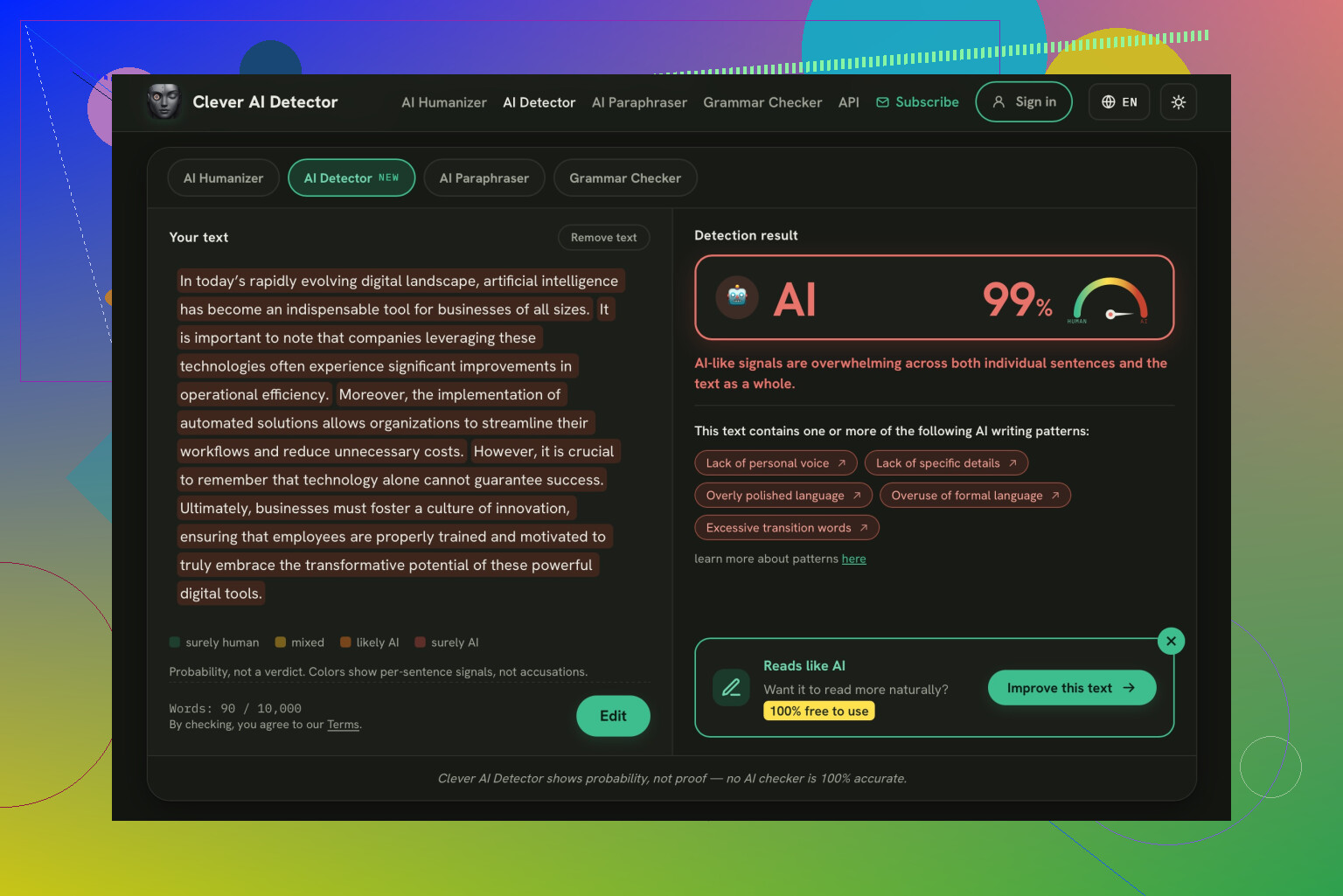
I’ll still open Clever AI Detector when I want a fast read on which passages a machine trips over, mostly because I can rerun without the login dance. My reservation is that on a draft already giving mixed signals, rerunning tends to hand you the same shrug in a slightly different number, so I don’t pretend the second run adds information. For the actual handoff, I’d do what @epicpixel8696x said and check your quotes and attributions are clean, then let the editor edit. That’s the part that survives contact with a human reader. A percentage doesn’t.
A “human” or “AI” label is not a conclusion but a likelihood the model has rounded before presenting it to you. Thus, if two of them have a different label, they are likely to have rounded differently on the model’s distribution, hence they are a couple of points from each other. Nothing to reconcile.
Where I’d push back a little is on all the talk about rerunning and cross-checking. The bigger trap is what happens after you get a scary flag: you start rewording perfectly fine sentences to satisfy a classifier, and that usually makes the prose stiffer, not better. @zerologic9529 already noticed you can’t tell what to fix, and that’s exactly why I’d stop before touching anything. If you can’t name the writing problem yourself, the detector didn’t find one.
I still use Clever AI Detector for times when I need a quick idea of what might be generic, but I have to say, its only real value is a general indicator, because it doesn’t show confidence levels, so you can’t really know if it’s accurate. Personally, I wouldn’t share the results with an editor, because they probably don’t need to know or care about the technicalities and probabilities, just if the text is clear and properly cited.